
The Reading at Barnard’s Inn
Number 45, Autumn 2025
Master Howard Morrison
Democracy and International Criminal Justice in the Fragile World of the Rule of Law
Master Clare Noon
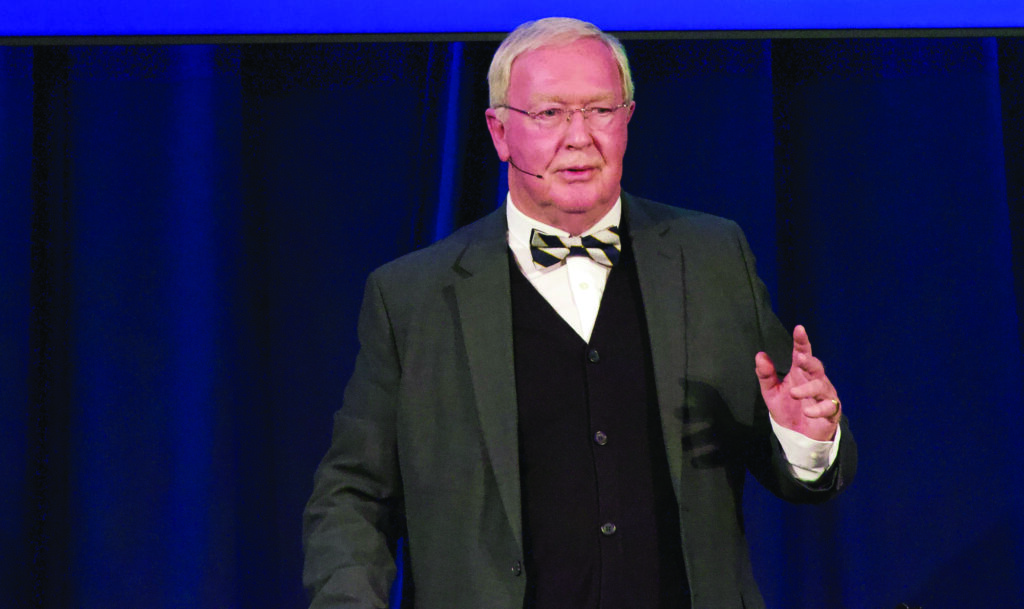
In a sell-out lecture on 9 June that was universally well received, Master Howard Morrison started with the first of a number of warnings:
‘It may be a few decades later than predicted but 1984 is knocking loudly at our door. We are seeing the word
“dystopian” in the media worryingly frequently, and I recall reading that a Russian General remarked a year
or two back: “Do not attribute your freedoms to your successes, but rather to our failures”.’
Democracy and the Rule of Law
Master Morrison listed the obvious advantages of democracy as: giving a platform to resolve different views and conflicts peacefully; a vehicle for respect for human dignity parallel with human rights; allowing freedom to act, speak and think independently as long as it doesn’t stop others from doing the same; providing a safe secure community; ensuring equality before the law and thus the rule of law; and helping to prevent, or at least discourage, autocracy.
He stressed that the rule of international law that governs the conduct of those in control of states, both internally and externally, is no different than the requirements to observe the rule of law in domestic society. If you have a system that does not allow for the unsullied rule of law domestically, the prospects of such a state working well with other states is very limited. And he warned that we have to be very aware that some nations on whom we have relied to be like-minded in the application of the rule of law and respect for customary international law and treaty based rules can no longer be relied on, certainly in part and, perhaps, at all.
Turning to Ukraine
A significant appreciation of the realities of Soviet attitudes and policy is necessary in order to begin to see what is happening in Ukraine and what might well happen elsewhere in the not too distant future. And not just Russia – empire building is contagious. Control is achieved through oppression and the application of divide and rule. The rule of law is also ignored or circumvented through cyber attacks, cutting undersea cables and localised arson attacks and the like – and particularly through domestic and broadcast propaganda and misinformation.
Naive illusions, or perhaps delusions, had led most to shameful inactivity in respect of the invasion of Crimea in 2014. Western politicians did not even begin to see the real and apparent dangers that that invasion illustrated. The Ukrainians did see it clearly, but had had precious little support.
What of International Criminal and Humanitarian Law?
A constant theme was a failure to learn the lessons of history. In terms of the fragility of the Rule of Law and the failures of the primacy of peace over conflict, one just had to look at the wars and conflicts we have endured over the last 120 years or so. We have overt dictatorships by any other name in North Korea, Iran, Belarus, China and Russia, with many other places qualifying to a greater or lesser extent. One might think that it is a miracle that the democratic ideal still prevails in as many states as it does. We have seen military force being used to engender political and even regime changes in recent history. Master Morrison was clearly both appalled and saddened by
disastrous mistakes that had resulted from the failure to have a coherent strategy in respect of Iraq, a country, and whose people, he knows well.
And another salutary warning: after 1991 Russia had reconstituted itself as a great power able to exploit the principal social divisions of its rivals with significant and strategic effect – to destroy the western liberal order and, thus, the rule of law.
The International Courts and Tribunals
Master Morrison saw the common theme running through all courts and tribunals as individual criminal responsibility – making people accountable for the damage they have done. Experience has shown that international courts and tribunals are only truly effective if they do not allow for the primacy of any claim of immunity. No defence of superior orders and very limited application of duress, the latter only affecting sentence.
The most obvious starting point was the Nuremberg and Tokyo tribunals that had followed on from World War II. Thereafter there had been a lull in the practical application of international criminal and humanitarian law until the establishment of the United Nations Tribunals for the Former Yugoslavia and Rwanda in the early 1990s. Sir Howard had defended in both and was also a judge in the Yugoslav tribunal.
Mention was made of a number of other international courts and tribunals, but the overarching and possibly most controversial creation was the International Criminal Court established in 2002 as a treaty court incorporating the founding Rome Statute. It is an international court as opposed to a universal court, as a number of very important states, including Russia, China and the United States, are not members and unlikely to join. Nevertheless there are 124 members most of which one would recognise as functioning democratic states. Unlike the Yugoslavia and Rwanda tribunals, which were creatures of the United Nations, the ICC has no UN Chapter 7 powers, whereby when a country was required by a court do something it obeyed, and therefore depends entirely on mature state cooperation, which it does not always get.
As well as such lack of support, the ICC is limited in what it can undertake. It has only three court rooms and 18 judges. When Master Morrison was at the court he was told by the German judge that its budget was the same as that of the Berlin fire brigade, yet it is very expensive to run investigations in a country that might not cooperate and where security, translation and interpretation were difficult and expensive. Master Morrison was also critical of the lack of appropriate experience of some of those appointed.
What of the Future
Master Morrison hoped for more universal jurisdiction; that more states would step forward and call out unacceptable behaviour and commit to dealing with it; that there would be more support for international courts and tribunals; and that all politicians would read the International Covenant on Civil and Political Rights. He feared where a continuation down the path of tolerating blatant breaches of international criminal and humanitarian law and the debasement of the Rule of Law and judicial independence might lead, and stressed that citizens, as well as governments, had a duty to see that democracy and the Rule of Law survived.
Master Howard Morrison is a former President of the Appeals Court of the International Criminal Court and a Bencher of Gray’s Inn.
A text of the Reading will be published in the next issue of Graya. The lecture is also available online on the Gresham College website.
Explore more from this edition
A conversation with Master Joshua Rozenberg
Master Stephen Wooler Master Rozenberg celebrated 50 years as a journalist this year. He has successfully combined understanding of the law, legal professions and justice system with a reputation for…
Dr Ambedkar’s ‘Living Document’
Master Timothy Shuttleworth reports on the 75th Anniversary celebration of the Indian Constitution at Gray’s Inn, honouring Dr. Bhimrao Ambedkar, a Gray’s Inn member and key architect of India’s democracy. The event, held on 5 June in Hall in collaboration with the Indian High Commission
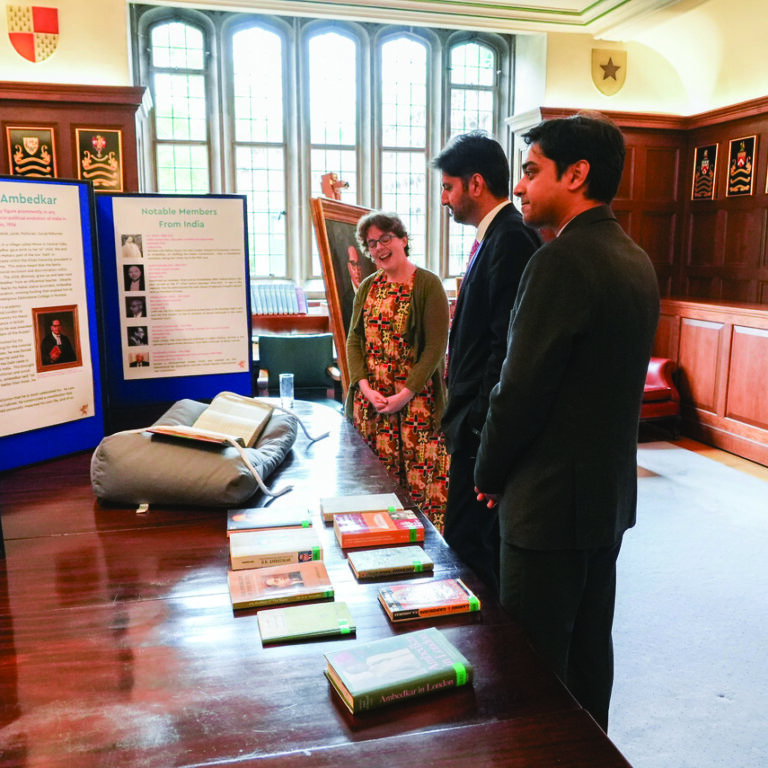
History Society Lecture
Master Clive Osborne reports on Professor Patrick Diamond’s History Society lecture, “From Boris Johnson to Donald Trump: Do western democracies get the leaders they deserve?”, exploring the qualities of effective political leadership and the structural and societal reasons why many democracies produce ineffectual leaders.

Philips 40 Years On
The Advent of PACE and the Crown Prosecution Service Master Stephen Wooler 23 May 2025 marked 40 years since the Prosecution of Offences Act 1985 received Royal Assent, establishing an…