
Philips 40 Years On
Number 45, Autumn 2025
The Advent of PACE and the Crown Prosecution Service
Master Stephen Wooler
23 May 2025 marked 40 years since the Prosecution of Offences Act 1985 received Royal Assent, establishing an independent prosecution service for England and Wales. Few of today’s practitioners are likely to remember a criminal justice system without the Crown Prosecution Service. The 1985 Act was the first major change to prosecution arrangements since 1879 when the Office of the Director of Public Prosecutions was created to handle (under the superintendence of the Attorney General) the gravest and most sensitive of cases. The clue is in the name: until then, responsibility for initiating and conducting prosecutions had rested with the victims themselves, sometimes assisted by police or local justices.
The next hundred years saw the police assume increasing responsibility for prosecutions. Local police forces (which numbered around 200 prior to the Police Act 1964) made their own arrangements. In some instances, individual officers conducted their own cases whilst in others presenting officers were used – usually sergeants or inspectors. Most forces used local firms of solicitors to prosecute the more serious cases not dealt with by the DPP and some bigger forces employed inhouse lawyers. With Home Office encouragement, prosecuting solicitors’ offices became more common in the decades after World War 2. But the position was patchy with some being part of the police force itself, some employed by the police authority and yet others by the local council. The common denominator was the solicitor/client relationship between the lawyers and the police who took the decision to charge and at all stages had control of the proceedings. The quality, size of departments and pay scales all varied considerably. The best chief prosecuting solicitors asserted their professional position strongly leading to firm but fair prosecutions. They enjoyed substantial independence because the police did not question their advice. At the other end of the spectrum, one or two had the reputation of ‘boot putters’ – aggressive and usually adopting the police line.
This hotchpotch of prosecution arrangements was compounded by lack of regulation and infrastructure in relation to police investigations where safeguards for suspects and police investigative powers were inadequate in shockingly equal measure.
Quite remarkably for a jurisdiction purporting to be based on individual liberties and the rule of law, there were no statutory provisions governing the detention of suspects such as the length of their detention or the conditions under which they could be held and interrogated. Habeas corpus was always in the background, but guidance was effectively limited to the 1912 Judges’ Rules. Amounting to about two pages, they provided guidance to English police forces on the detention and questioning of suspects. These rules aimed to standardise procedures and prevent evidence from being deemed inadmissible in court due to improper conduct. They were not laws, but rather administrative directions for police, focusing on fairness in the administration of justice. Their generality and reliance on interviewing officers’ notes made up after interview combined to ensure countless hours of court time expended daily determining issues of admissibility.
On the investigative side, police powers to search for and seize evidence were woefully inadequate. For example, there was no right to take samples of blood, hair and urine etc for forensic examination – highly important even before the advent of DNA. Banking and journalism were minefields for investigators seeking evidence. All too often the only advice lawyers could offer to investigators was to ‘use their powers under the Ways and Means Act’.
In the 1970s the then Home Secretary (Merlyn Rees) and the Attorney General (Sam Silkin) shared concerns about both investigation and prosecution. Apart from the obvious questions about fairness and balance, poor practice was causing the courts to be cluttered by weak and badly prepared cases doomed to failure. So in February 1978 a Royal Commission, chaired by Sir Cyril Philips, was established to examine criminal procedure generally. Its report in January 1981 paved the way for seminal change in both investigation and prosecution. The Home Office prioritised reform of the investigation process and in the autumn of 1982 introduced what was to become the Police and Criminal Evidence Act 1984 (PACE) – the current centrepiece of criminal justice. It needed two attempts to get to the statute book because the first Bill fell when Margaret Thatcher called the 1983 General Election to capitalise on the boost provided by the Falkland victory.
Next up was prosecutions. The Prosecution of Offences Bill, introduced in the House of Lords in November 1984, received all-party support in both houses with debate focusing on the importance of a truly independent prosecution service and the preservation of local justice. The Philips Report had recommended the establishment of an independent prosecution service but set its face firmly against a national service observing:
‘We know of no common law jurisdiction in which the equivalent of a national prosecution system of the type we are discussing covers an area with anything approaching the population of England and Wales (although some are geographically much larger) or deals with a crime load of anything like the same order of magnitude.’
The decision to opt for a national service was out of character in several respects with the general approach of the government of the day. It involved wholesale transfer of staff into the civil service against the trend of reducing numbers and moving some prosecution work from the private sector to the public sector in an era of privatisation! Whilst the natural centralising tendency of the civil service may have played a part, a major driver was undoubtedly the difficult relationship between the government and local authorities in some parts of the country giving rise to concern about possible improper political influence on the prosecution process. One chief prosecuting solicitor in an area where prosecuting solicitors were locally funded had reported threats that funding would be cut off if miners were prosecuted.
Implementation was always going to be a challenge. Over 30 existing prosecuting departments had to be merged into one organisation along with the former DPP’s office and the Metropolitan Police Solicitor’s Department (MPSD) which was surprisingly small for the size of the force. The vast majority of Met cases were conducted by the investigating officer in person which meant that at 10.00am daily London courts were heaving masses of policemen jockeying for their position in the list – and most of them earning good overtime! Consultants were engaged to advise on structure and governance – resulting in the original 31 areas – a number that has since fluctuated between 42 and 13.
An overall budget for the CPS had to be negotiated with HM Treasury which also had to agree the gradings and pay scales being negotiated for its staff – a process which was complicated when the Treasury view that prosecuting was ‘low grade legal work’ became known to the Prosecuting Solicitors’ Society. Was the CPS underfunded: yes and no. The Treasury view of prosecution work meant the Service did not receive the funding needed to deliver to the expected standard. Its first-year budget was £193million which resonated with the author because it was almost the same amount the government paid in professional fees to those responsible for the British Telecom flotation! Paradoxically, difficulties in recruiting meant that much of the CPS was underspent at the end of the first year. What the Treasury did like was Part II of the 1985 Act which dispensed with the system of prosecution costs ‘out of central funds’ on a case-by-case basis because the CPS would be funded through the parliamentary Vote system – much easier to control.
With so many things to be worked through – not least recruiting the many additional lawyers required and acquiring suitable premises for them – a significant lead-in period was needed. It was not to be. For separate political reasons, the Government had decided to abolish the six Metropolitan Counties from 1 April 1986. They employed the prosecutors in their areas and a vacuum would result if the CPS was not in place by then – just 10 months after Royal Assent. Ministers were persuaded to compromise with the CPS going live in the Metropolitan Counties in April 1986 and the remainder of England & Wales following in October. It was headed for the first year and until he retired by Sir Thomas (Tony) Hetherington.
Even those areas where prosecuting departments already existed needed additional lawyers. Six police forces had no such offices and had to be staffed from scratch and London required between 250 and 300 extra lawyers as well as support staff. However, the Big Bang reforms implemented in October 1986 attracted many prosecutors with fraud and regulatory experience to the new self-regulating organisations. When serving as a chief crown prosecutor, the author was once introduced at a local Law Society dinner as ‘the man who each morning performs the miracle of five loaves and two fishes but uses lawyers instead.’
Heavy reliance on local solicitors and young barristers to cover magistrates’ courts advocacy demoralised the permanent staff who earned less but still had to deal with all the ‘back office’ work for those cases. Similarly, a scheme for short-term secondments of lawyers into London was double-edged because their generous expenses meant they earned far more than the permanent London staff.
Developing working relations with the police was not easy. Although they had persuaded Philips that they should retain the initial decision whether to charge, most disliked the concept of independent review and the CPS right to discontinue cases. The requirement for the CPS to authorise charges in certain categories of case came much later. Some police officers also struggled with the need to present prosecutors with evidence to support charges – especially those officers who had been accustomed to handling their own cases (and frequently received overtime pay for doing so). Nor did they like the CPS deciding whether or not to oppose bail, often a bargaining chip in relationships with suspects. For its part, the CPS sometimes struggled to find the right balance as regards its independence and sought to operate too much in isolation.
The magistrates’ courts were generally reluctant to change practices (especially listing practices) to accommodate the CPS, but generally less hostile. It was perhaps inevitable (and desirable) that the independent element the CPS was intended to introduce would disturb some cosy arrangements. For a long time, those courts unaccustomed to working with full-time prosecutors did not understand the need to assign cases to particular courtrooms in advance of the day so prosecutors knew which cases they would be handling and could prepare.
1986 also saw the promulgation of the first PACE codes – the Home Office having taken a more measured approach to implementation. The CPS therefore had a turbulent start. It was the new kid on the block trying to establish itself in a criminal justice system undergoing major transformation after nearly a century of neglect. By the time of the Glidewell Review of the CPS in 1998, it was on its fourth management structure as it vacillated between centralisation and more local focus. But now both PACE and CPS are simply givens within a highly centralised but creaking criminal justice system. That might prompt some people to wonder whether there is a causal link between the steps taken over the past decades to bring all the main agencies of the criminal justice system under greater central control (and the iron grip of the Treasury) and its current sorry state. But that’s another story!
Explore more from this edition
A conversation with Master Joshua Rozenberg
Master Stephen Wooler Master Rozenberg celebrated 50 years as a journalist this year. He has successfully combined understanding of the law, legal professions and justice system with a reputation for…
My Call to the Bar
Master Richard Hawkins reflects on his early days at the Bar, from his pupillage with John Mathew in 1963, through his first criminal trial and fortunate acquittal, to working with Dick Lowry and Nina Lowry, the first woman appointed as a judge at the Old Bailey.
Popular Myths at Gray’s Inn: The Night of Errors
In this article, Master Timothy Shuttleworth examines the first recorded performance of Shakespeare’s The Comedy of Errors at Gray’s Inn in 1594, famously attended by the Lord Chamberlain’s Men. Focusing on the debate over the precise date of the staging, Shuttleworth weighs the evidence from contemporary records, Gesta Grayorum, and later scholarly analysis. The piece situates this landmark performance within the history of Gray’s Inn and its connections to Elizabethan theatre.
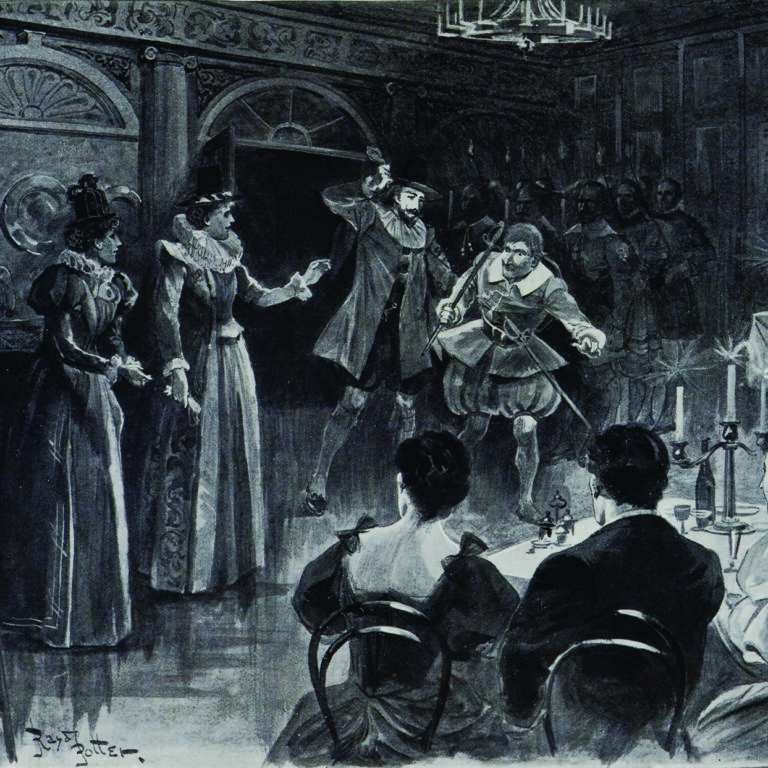
The Reading at Barnard’s Inn
Master Howard Morrison Democracy and International Criminal Justice in the Fragile World of the Rule of Law Master Clare Noon In a sell-out lecture on 9 June that was universally…