Popular Myths at Gray’s Inn: The Night of Errors
Number 45, Autumn 2025
Master Timothy Shuttleworth
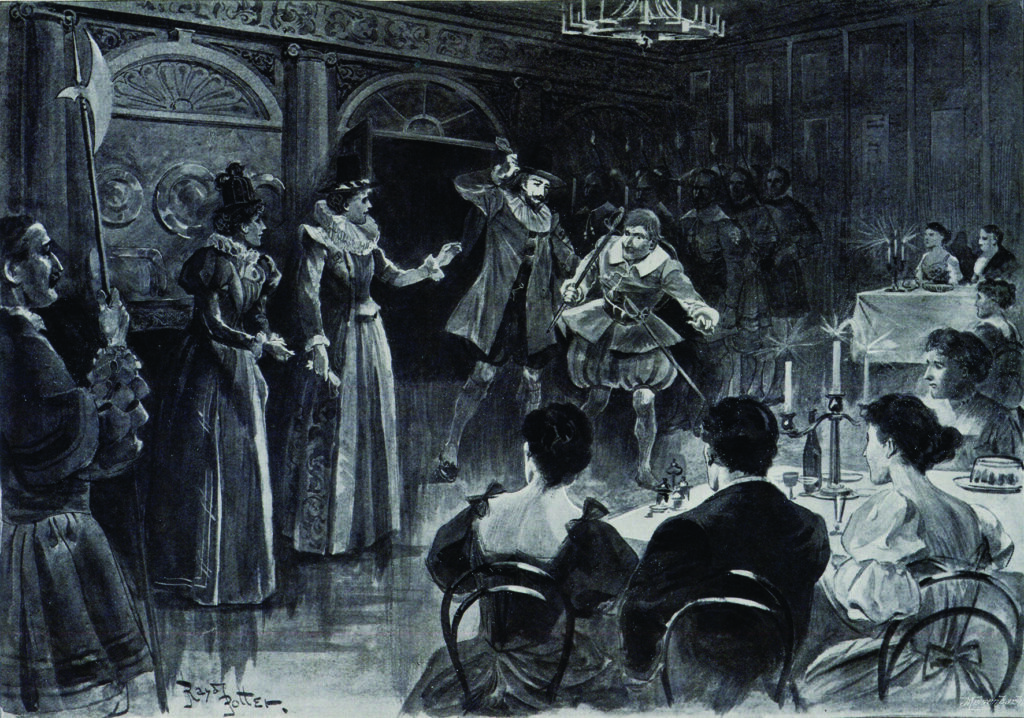
In 1594, nearly 451 years ago, Shakespeare’s play ‘The comedy of Error (hereafter “Errors”) received its first recorded staging in the Hall at Gray’s Inn. The troupe engaged to perform the entertainment was the Lord Chamberlain’s Men (Shakespeare’s Company) with Shakespeare almost certainly in attendance and probably even participating in the actual production by playing the small part of Dr. Pinch.
There was such a throng crammed into Hall that night that many left early in disgust, largely guests from Inner Temple (‘the Templars’) to whom special invitations had been extended. Thereafter the evening was known as the ‘Night of Errors’.
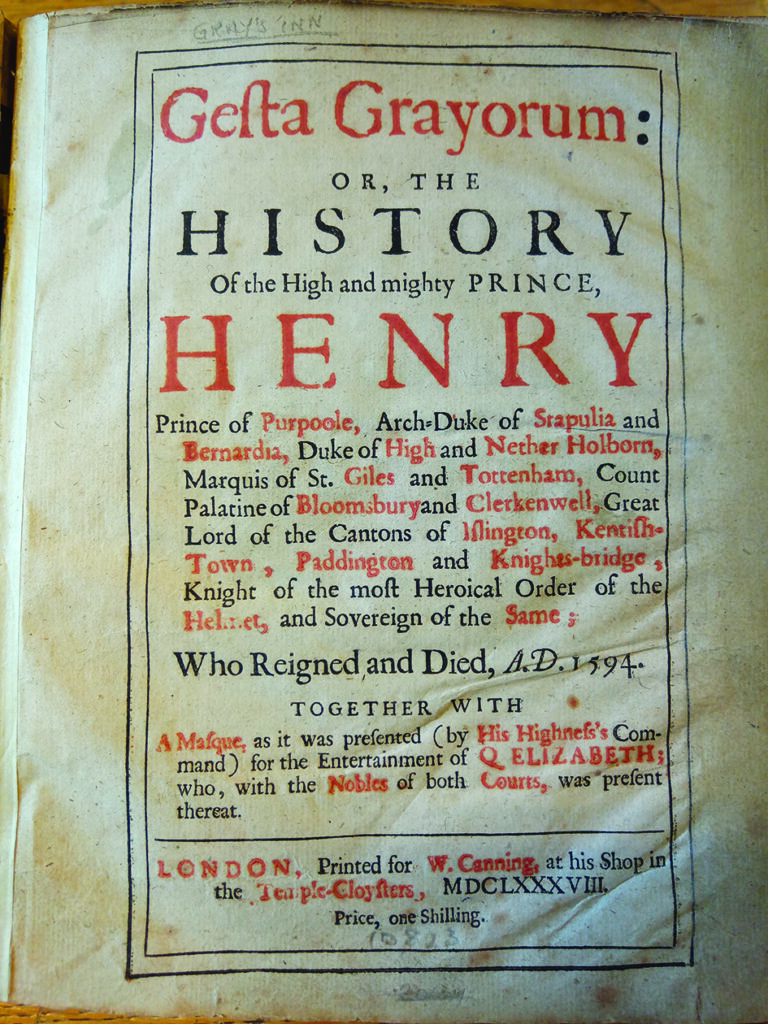
The only source for this performance of ‘Errors’ at Gray’s is Gesta Grayorum (hereafter Gesta), a contemporaneous record written by someone (we don’t know who) present at the time of the events described. The account was not published until 1688 and we don’t know where it was kept between 1594 and its publication.
Nobody seeks to challenge the authenticity or accuracy of Gesta save in one respect, the precise date of the performance.
Before concentrating on the mythology surrounding the staging of the play, to which I will return in the next issue of Graya News, I shall consider here the precise date of its performance in 1594.
The Date of Performance
Gesta states that the performance of “Errors” took place at the Inn in 1594 innocents-Day at Night’, being the Feast of Holy Innocents which occurs on 28 December. That could not be clearer. But some academics cannot accept that date, arguing that the correct date is 27 December.
The Debate
The reason for the doubt is that the records held by the Royal Household appear to show that the Chamberlain’s Men were paid for playing before the Queen at her Palace at Greenwich on the same day as ‘Errors’ was performed at Gray’s, i.e. 28 December 1594.
In the Arden edition of the play (2016), Kent Cartwright, Professor Emeritus of English at the University of Maryland, references the distinguished British scholar Sir Edmund Chambers who died in 1954. It is the latter who has hypothesised that Gesta is wrong and the date of the performance at Gray’s ought to read 27 December. Cartwright adds that Chambers explanation ‘has been generally accepted; the alternative would be to imagine that the company played twice on the same day in different locales, once before the Court and again in the evening at Gray’s Inn’.
Contrary to Cartwright’s bold assertion, the date of 27 December is not ‘generally accepted. Both Ros King, Professor Emeritus of English at Southampton University, in her Introduction to the play in the New Cambridge Shakespeare series, and Randall Martin, Professor of English at the University of New Brunswick, in an essay in the Penguin Classics series devoted to ‘Errors, accept the date of 28 December without challenge. Even absent their endorsement, it is only too believable that the hardworking Chamberlain’s Men, including many talented boy actors, performed twice in a day. More to the point, it is Clear, as Gesta emphasises, ‘Errors’ was staged at night, perhaps even very late at night giving the Company sufficient time to reach the Inn from Greenwich. It was certainly well after 9 o’clock that the play was performed because the Templars didn’t reach Gray’s until ‘about Nine of the Clock at Night’ (per Gesta) and much occurred after their arrival (including their departure!), followed by “Dancing and Revelling with Gentlewomen’ before ‘Errors’. began (again per Gesta).
Could the Court Record be Wrong?
But why should Gesta be wrong and not the Court record? That is certainly the view of the distinguished Shakespearean scholar the late R.A. Foakes, who edited an earlier Arden edition of the play. He suggests that the court record is mistaken and should read that the Chamberlain’s Men were paid for a performance at Court on 27 December, not 28. The Malone Society in its reprint of Gesta (1915) adopts the same view.
Charles Whitworth, Emeritus Professor of English Literature at Montpellier University also concurs in his Introduction to the play in the Oxford Shakespeare series (2008). He goes further and identifies the Admiral’s Men (not the Chamberlain’s Men) as the likely troupe paid for their performance at Court on 28 December leaving Shakespeare’s Company to perform at Gray’s on that date.
Other Clues to the Date.
The next recorded performance of ‘Errors’ was before James l on Holy Innocents Day, 28 December, 1604, (it was described as the ‘Plaie of Errors’ by Shaxberd, illustrating once again the inconsistency of spelling, particularly of surnames at the time.) The Company engaged was Shakespeare’s players, now newly re- named the King’s Men. The date chosen is surely cogent evidence to support the original performance at Gray’s being Holy Innocents Day 1594. Why choose this precise date in 1604 if the original performance was a day earlier?
It has even been argued that Francis Bacon may have suggested to the King that “Errors’ should be played before him that year as part of the Christmastide entertainment.
That too may be significant because Bacon is one of the candidates for writing at least some parts of the Gesta account.
Explore more from this edition
History Society Lecture
Master Clive Osborne reports on Professor Patrick Diamond’s History Society lecture, “From Boris Johnson to Donald Trump: Do western democracies get the leaders they deserve?”, exploring the qualities of effective political leadership and the structural and societal reasons why many democracies produce ineffectual leaders.

Inn the Village: Havens for the spirit – Part II
Daniel Dovar explores four historic and cultural institutions near Gray’s Inn, from the architectural and historical richness of St Dunstan’s in the West and St Andrew Holborn, to the vibrant cultural offerings of Pushkin House and the Swedenborg Society.
Trinity Call 2025
The Treasurer called to the Bar 78 members of the Inn in late July. As has become a new convention for Trinity Call, the ceremony of Call took place in…
The Summer Extravaganza
Amy Oliver On Saturday 26 July, Gray’s Inn members and their guests stepped back in time at the Summer Extravaganza, exchanging the 2020s for the 1920s in all their glitz…