Summer Concerts
Number 45, Autumn 2025
An Unlikely Pairing: The Music of J. S. Bach and Arvo Pärt
Master Robert Coren
On paper the recipe reads like a salad of watermelon with feta or making ice cream with black pepper or chilli … an improbable if trendy summer taste combination that probably originated with Nigella, even without her ‘microwavé’.
But the unlikely pairing of music by foundational Baroque star Johann Sebastian Bach with contemporary minimalist giant Arvo Pärt proved surprisingly coherent and logical during 2025’s first Summer Concert in Gray’s Inn Chapel on 10 June. Our own Bar rockstars proved more than capable of serving up so flavoursome a fusion.
Ian Wilson kicked off the evening on the Chapel organ with Bach’s Fantasia in G Major BWV 572, a piece that starts with childlike cheeriness before later reaching sophisticated grandeur. Ian, whose scholarship on the instrument has taken him from Cambridge to Texas, to Wellington in New Zealand and then back again to Cambridge, did well to remind us of the composer’s toccata writing and rightful place in musical history.
Pärt’s opening outing was the Estonian’s best-known work, the reflective Spiegel im Speigel. Played by Damian Falkowski on violin and Christopher Bowers-Broadbent on piano, the strippedback simplicity of basic arpeggios was again at odds with the concentration and precision required to play them well, not to mention the spell of profound pathos they cast. It was great to hear the piece with violin as originally written, rather than cello.
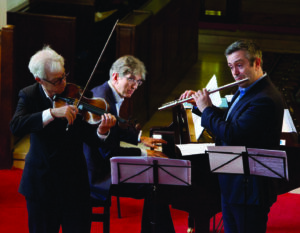
Next came Paul Skinner with the Flute Sonata in E Flat Major BWV 1031 and Ian Wilson now on piano. Whether this work is all by J. S. Bach (or even at all by him) is a matter of some academic debate, and it was fun trying to decide as Paul gave its three movements effortless summery zip. Damian Falkowski returned solo with the Adagio instead of the listed Fugue from Sonata No. 1 in G Minor BWV 1001, executing with aplomb the same dextrous double and triple stopping I delight in tasking him with during Miscellany.
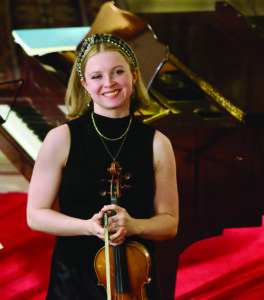
The next generation of Gray’s virtuosi was represented by Clara Falkowska, Damian’s daughter, an Inn musical regular through childhood and now a Gray’s scholar heading for her own career in law. On violin she gave us Allemande from Partita II in D Minor BWV 1004, a Renaissance and Baroque dance elegantly played not from sheet music but from an iPad, as if to show her seniors how things should be done these days. Damian and Ian returned with three of the four movements from Sonata IV in C Minor BWV 1017, the closing Allegro of which Damian likened to the high speed and abject terror of the motorcycle TT Races just run across the Isle of Man, where he now lives.
Perhaps the highlight of the evening was two Pärt solo organ works played by Christopher Bowers-Broadbent. The organist and choirmaster of Gray’s Inn Chapel is a leading interpreter of Pärt’s repertoire on the instrument, has worked with the composer and has even had pieces written by Pärt for him. So, what a treat it was to hear Christopher play the contrasting Pari Intervallo and later Annum per Annum, both of which he has previously recorded for ECM Records. Pari Intervallo was written after the death of the composer’s stepfather, originally in four parts without specifying instrumentation. It is as sparse and transcendent as minimalist music can be, with two parallel voices remaining the same distance apart throughout, hence the name.
Annum per Annum starts with an introduction of equal simplicity but crashing volume. Five distinct movements then invoke the Mass: Kyrie, Gloria, Credo, Sanctus and Agnus Dei. The piece’s coda crescendo requires playing the organ with percussive effect in ways I suspect few of us in Chapel will ever have heard before.
The boyish Christopher turned eighty earlier this year. How extraordinary he is to have remained at the cutting edge of contemporary music for so long, and here’s to many more annums of his continuing to do so!
When I was a student, Douglas Hofstadter’s ‘Gödel, Escher, Bach: An Eternal Golden Braid’ was the mustread (if 750-page!) cross-discipline ‘metaphorical fugue’ exploring intellectual connections between J. S. Bach, the logician Kurt Gödel and the graphic artist M. C. Escher. This concert became an equally entertaining dialogue, debating Bach’s rigorous counterpoint and perfect musical architecture against Pärt’s radical simplicity and famous ‘tintinnabuli’ compositional technique. But the two very different ingredients worked so well together on the plate! The composers have in common an underlying spirituality, which led Lutheran Bach to inscribe his scores ‘to God alone be the glory’, and the Orthodox Christian Pärt to write music of such calming meditative stillness that it deeply sates current cultural hunger in a noisy age.
Paul, Damian and Ian ended the concert with the Affettuoso from Bach’s Brandenburg Concerto V BWV 1050. They also played a flute, violin and piano encore of the Prelude and Fugue in C Major BWV 846 from The WellTempered Clavier. This is the tune Charles Gounod later reshaped as Ave Maria, which I first learnt from a music box owned by my grandparents. Arvo Pärt used it in a different Credo. Leave fans with the hits, to hit them in the feels!
All in all, this first summer concert of 2025 was a triumph of both programming and performance. There was an equally well-paired supper in Hall after the music also to enjoy, and the evening left its audience, just like Bach’s clavier, uniformly well-tempered.
Orpheus Britanicus With the Mayfield Concert
Master John Uff
The concert in Chapel on 17 June 2025 gave us a feast of late 17th century delights by the two leading English composers of the period – the much celebrated but shortlived Henry Purcell (1659-1695) and his mentor and friend John Blow (1649-1708), less well known but presenting us with a fascinating contrast between the two. For Purcell we heard some of his choicest and most popular works – the so-called Bell Anthem (Rejoice in the Lord alway), the Chacony in G minor and the less familiar setting of ‘I was Glad’ from psalm 122. Between these gems we were given John Blow’s Salvator Mundi, a rarity in the setting of a Latin text written in the 1670s, and ‘God spake sometime in vision’ which, together with Purcel’s verseanthem ‘My heart is inditing’ was written for the 1685 Coronation of James II, the brother of Charles II, whose Catholic leanings eventually led to regime change via the Glorious Revolution of 1689.
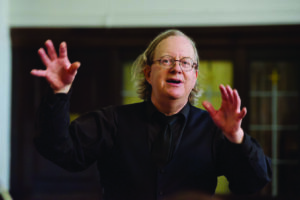
These outstanding musical presentations were given by the Mayfield consort, a double choir of talented amateurs with some professional singers (mirroring the Gray’s Inn choir), organised and conducted by David Force, a celebrated and highly qualified writer, musicologist and specialist in the period. The singers were accompanied by the delightful sound of a contemporary baroque string ensemble comprising two violins and viola, accompanied by a bass violin’ and a now more familiar theorbo. The bass violin appeared to be indistinguishable from a cello, but in this case tuned down to B flat. The string players gave an elegant performance of the two chaconnes and also provided authentic accompaniment to the choral works. The continuo was provided by our own Ian Wilson on the chapel organ.
The performances gave the rare opportunity to hear these two famous composers almost in competition – indeed we were given the fascinating background to the Coronation at which both the Blow and the Purcell verse anthems were performed by an 8-part choir and soloists, singing from a specially constructed tiered platform in Westminster Abbey. This must have been the highpoint of the otherwise troubled reign of King James II. Here was a fascinating slice of English history as well as music, presented in a proper liturgical setting. Sadly, in parallel with the reign of James, this flowering of English Baroque choral music was to be short-lived and both Purcell and Blow reverted, in their later years, to earning their living through the London theatre.
But the performance did not end there – David Force produced a wonderful encore in a short, intense and unfinished choral piece which seemed to contain the very essence of Purcell’s art, leaving us all with the thought of what might have been.
The Treasurer’s Midsummer Concert
Master Oscar del Fabbro
This concluded this year’s music summer season. Little wonder the audience awaited in eager anticipation for the debut of the Gray’s Inn Orchestra led by the Inn’s very own Master Damian Falkowski at the Treasurer’s Midsummer Concert. The balmy midsummer evening with the sun streaming into Hall added to the atmosphere as if there was some moment of magic in the air. The array of orchestral musicians on the dais were under the baton of Timothy Redmond, Professor of Conducting at the Guildhall School of Music. The opportunity to spot colleagues and familiar faces about to perform was short-lived as Felix Mendelssohn’s ‘A Midsummer Night’s Dream’ overture was the opening fanfare (or flourish) of the programme.
There is seldom a time when this vibrant musical depiction of Shakespeare’s play, blending romanticism with classical structure, does not have the effect of creating a tangible magical atmosphere as it did in Hall from the opening bars. The ethereal fairy world, the royal court, and the bumbling mechanicals were all recreated in this intimate setting. The players responded with concentrated enthusiasm. It is unlikely that there was much time for rehearsals with several musicians filling in at short notice. But, as if by magic, it all came together to imbue the Hall with a charming performance.
How perfectly Mendelssohn captures the spirit and essence of Shakespeare! Four suspenseful and transforming chords open the overture followed by the first theme, a scurrying, busy motif involving intricate rhythms on the strings representing the dancing fairies. Despite the popularity of and familiarity with this piece, it is only when hearing and observing the playing at close quarters that its complexity and intricacy are revealed. As the programme notes reminded us, Mendelsohn was 17 years old when he wrote it. A fanfare-like transition (the royal music of the court of Athens) leads to a second, lyrical theme for the lovers. A final group of themes, suggesting the craftsmen and hunting calls, closes the exposition. The fairies dominate as the next section develops, and ultimately have the final word in the coda, just as in Shakespeare’s play. But there couldn’t be midsummer music without a reference to Bottom, who gets turned into a donkey and is depicted with a braying ‘hee-haw’ in the strings.
Little wonder that Marin Alsop, a genius conductor in her own right, commenting on the piece in 2014, disclosed that Shakespear’s play contained one of her favourite lines: ‘Lord what fools these mortals be!’ But when she hears Mendelssohn’s music all she can think is: ‘Lord, how brilliant can one man be?’. She was certainly not alone judging from the appreciative applause.
Vaughan Williams’ Fantasia on Greensleeves, as the program notes implied, continued the Shakespearian theme, as the piece was derived from incidental music to the composer’s opera ‘Sir John in Love’ based on ‘The Merry Wives of Windsor’. The familiar folk tune was interwoven by some excellent interplay between harp and flute creating another ethereal setting in the mind’s eye of the woods of Windsor Park where Mistress Ford had invited Falstaff to meet her, only to be teased and pinched by the children dressed as fairies.
Elgar’s String Serenade is sometimes referenced to Shakespeare’s ‘Romeo and Juliet’ and the last movement performed by the string section reflected a sense of youthful vitality in keeping with the hopes and aspirations of the young couple. The rich texture of the music and expressive melodies combined with a variety of string techniques added to the atmosphere in Hall. Under Damian Falkowski’s leadership the strings gave this showcase piece a masterful rendition, leaving one marvelling at the array of musical talent within our midst.
Finzi’s Violin Concerto was an absolute eye-opener in more ways than one. Apart from the fact it was only discovered many decades after the composer’s death in 1956 and is rarely performed, with recordings even rarer still, it was the Master Treasurer’s solo performance that provided the audience with some stunning moments of awe at the talent and skill on display. Emerging from the back row of the violins where Master Treasurer had taken her place in the ensemble, she performed this 20-minute work with aplomb and confidence to stunning effect.
The piece is known for its beautiful slow movement but there was so much more to admire. The concerto is structured in three movements: a six minute allegro, the molto sereno slow movement, and a Hornpipe rondo, which challenges the soloist in so many respects in terms of fingering and bowing. Master Treasurer’s focus and concentration on the score was evident but the music which emerged was again little short of magical. The technical challenges represented by the three movements are reminiscent of neo-classical toccata with elements of Vaughan Williams and Stravinsky, and Master Treasurer’s playing set the right tone in its energy and beauty.
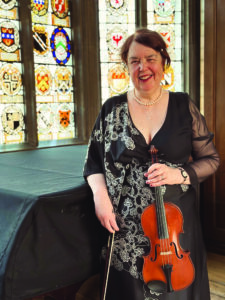
The ensemble were carried on the wave of this compositional gem of engaging, charming music. They left the audience in awe at this memorable performance as was shown by the well-deserved rapturous applause.
The finale of Haydn ‘London Overture’ provided a fitting conclusion to this delightful evening of music making in Hall. The spirit of past players, musicians and actors who over the centuries have featured in the life and traditions of the Inn was very much alive on this balmy evening. There was indeed magic in the air this Midsummer’s Night.
Gray’s Inn Chamber Orchestra/Summer Concerts
Conductor: Timothy Redmond
Leader: Damian Falkowski
Violin I
Damian Falkowski
Nicola Bedwin
Serena Leader
Rosalind Falkowska
Christopher Gundry
Kate Bailey
Violin 2
Paul Gray
Adrienne Freeman
Teresa Coakley
Jeremy Cook
Alison Gabriel
Geraldine Andrews
Clara Falkowska
Viola
Stephen Brown
Maya Lester
Rosemary Cook
Susannah Rang
Janet Farrell
Cello
Lana Wood
Ann Sheffield
Shannon Do
Dirk Stuff
John Mehaffy
Double Bass
Florence Challands
Harp
Rachel Carver
Flute
Paul Skinner
Kerenza Allin-Garner
Clarinet
Quentin Maxwell-Jackson
Curtis Crowley
Oboe/Cor Anglais
Nora Wannagat
Bassoon
Maria O’Dea
Sarah Byrne
French Horn
Anthony Mann
Derek Holland
Trumpet
Clara Falkowska
Dylan Lerner
Timpani
Richard Souper
Explore more from this edition
From the Treasurer
Master Geraldine Andrews I am often asked the well-meaning but misguided question: ‘how are you enjoying being Treasurer?’ Being Treasurer is not about having a good time, as the question…
Dr Ambedkar’s ‘Living Document’
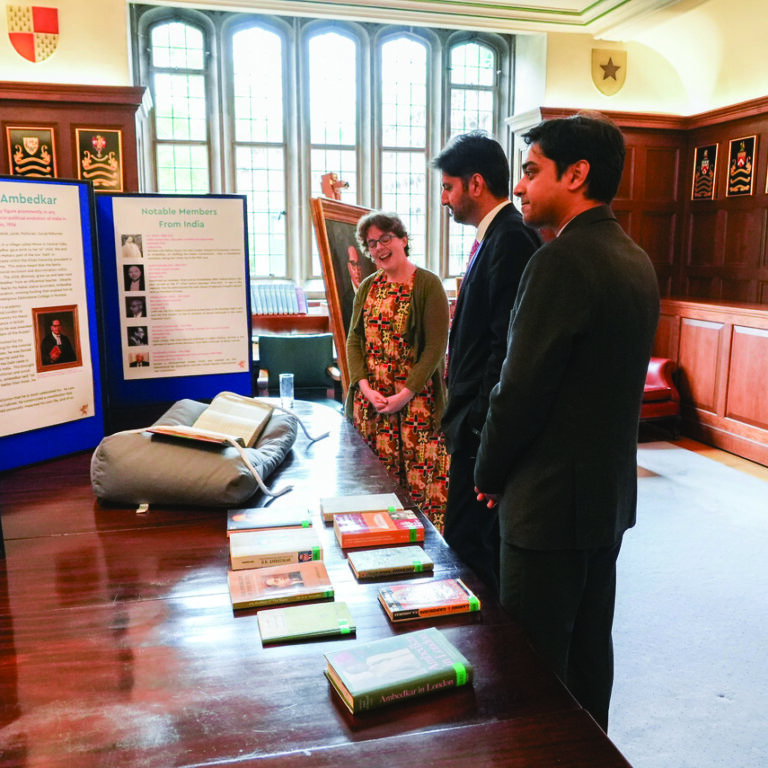
Master Timothy Shuttleworth reports on the 75th Anniversary celebration of the Indian Constitution at Gray’s Inn, honouring Dr. Bhimrao Ambedkar, a Gray’s Inn member and key architect of India’s democracy. The event, held on 5 June in Hall in collaboration with the Indian High Commission
History Society Lecture
Master Clive Osborne reports on Professor Patrick Diamond’s History Society lecture, “From Boris Johnson to Donald Trump: Do western democracies get the leaders they deserve?”, exploring the qualities of effective political leadership and the structural and societal reasons why many democracies produce ineffectual leaders.
The Reading at Barnard’s Inn
Master Howard Morrison Democracy and International Criminal Justice in the Fragile World of the Rule of Law Master Clare Noon In a sell-out lecture on 9 June that was universally…