Dr Ambedkar’s ‘Living Document’
Number 45, Autumn 2025
Master Timothy Shuttleworth
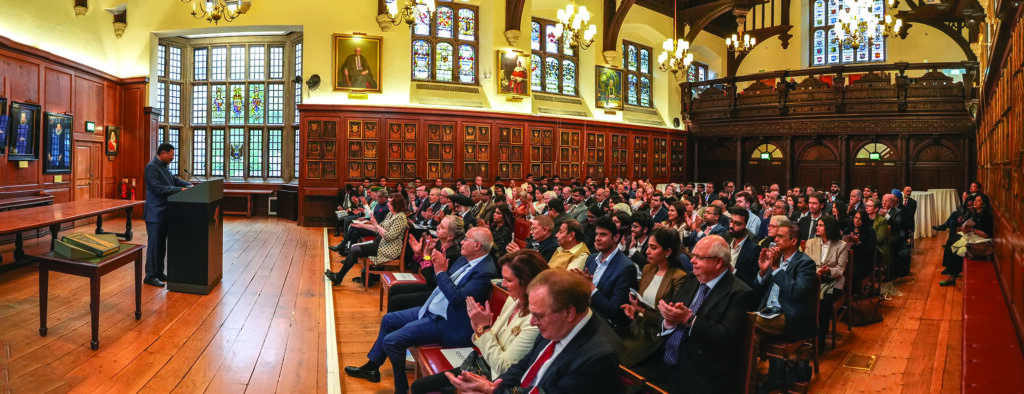
This year marks the 75th Anniversary of the formal declaration of the Indian Constitution, largely the creation of Dr. Bhimrao Ambedkar, Minister of Law and Justice immediately following Indian Independence. He was an economist and social reformer too, who as a young man was admitted to Gray’s Inn in 1916 and later called by the Society in 1922. To celebrate his remarkable achievements, a lecture and a series of tributes to Dr Ambedkar (known by his followers as ‘Baba Saheb’ in gratitude) were given in Gray’s Inn Hall on 5 June under the title ‘The Living Document of the Constitution of India, and the enduring relevance of Dr. Ambedkar’.
The occasion and the subsequent reception in Hall were hosted by the Inn in close co-operation with the Indian High Commission. That the Chief Justice of India (Justice Bhushan Ramkrishna Gavai) was present was clear confirmation of the continued importance India attaches to the connection between Dr Ambedkar and Gray’s Inn. That was equally true of the Inn itself as warmly endorsed by the Treasurer, Master Geraldine Andrews, who in her words of welcome emphasised how proud the Society was that Dr Ambedkar had chosen to join Gray’s Inn.
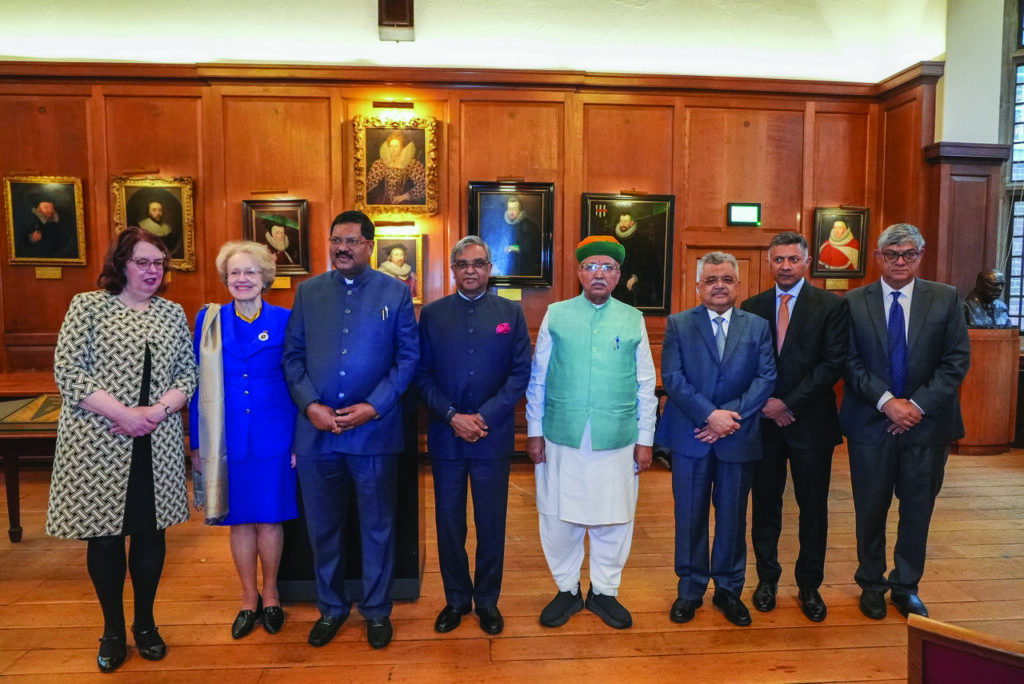
The speeches that followed the introductions from Lady Arden of Heswall, former Justice of the UK Supreme Court, were delivered by the Chief Justice of India (‘CJI’) who gave the main address (the full text of which will be published in Graya 139) and Justice Vikram Nath, Justice of the Supreme Court of India. The other speakers were Mr Arjun Ram Meghwal, Minister of Law and Justice for India and His Excellency Vikram Kumar Doraiswami, High Commissioner of India to the United Kingdom.
Each speaker spoke in salutation of Dr. Ambedkar’s lasting legacy and painted this picture:
(a) That the Indian Constitution lay at the heart of the nation’s democracy and was ‘a living document of Justice’ (per CJI)
(b) That the Constitution had evolved over time to meet the ever-changing needs of Indian Society thus illustrating the Constitution’s ability to be flexible when required; it promoted equal rights and ‘continues to grow with us’ (per Justice Nath)
(c) That Dr. Ambedkar was one of the greatest legal minds of recent history (per CJI) who had (per Mr. Meghwal) ‘a timeless wisdom’. That same intelligence ensured that the Constitution also guaranteed women’s political rights and universal adult suffrage (per Mr. Meghwal). It was a matter of pride (said the CJI) that India over the last 75 years has ‘witnessed two women Presidents and now we have a woman President (Droupadi Murmu) who also represents the most marginalised sections of society, all in keeping with Baba Saheb’s vision of inclusiveness’. And (in referring to himself) the CJI remarked ‘I take pride in saying that India has a Chief Justice who (similarly) comes from a marginalised section and humble background’, i.e. the same Dalit social background as Dr. Ambedkar.
(d) That Dr Ambedkar saw both equality and patrimony (in the sense of ‘heritage’) as being important, ‘one without the other defeated democracy’ (per CJI).
(e) That in 1947 India was a country of 400 million people who were living under a ‘peculiar feudal structure’ (per the High Commissioner) and heading towards the dislocation and violence of partition. At the same time, Indians not only felt, but were unequal. That inequality was replaced by Dr. Ambedkar’s Constitution which was fit to rule a continent.
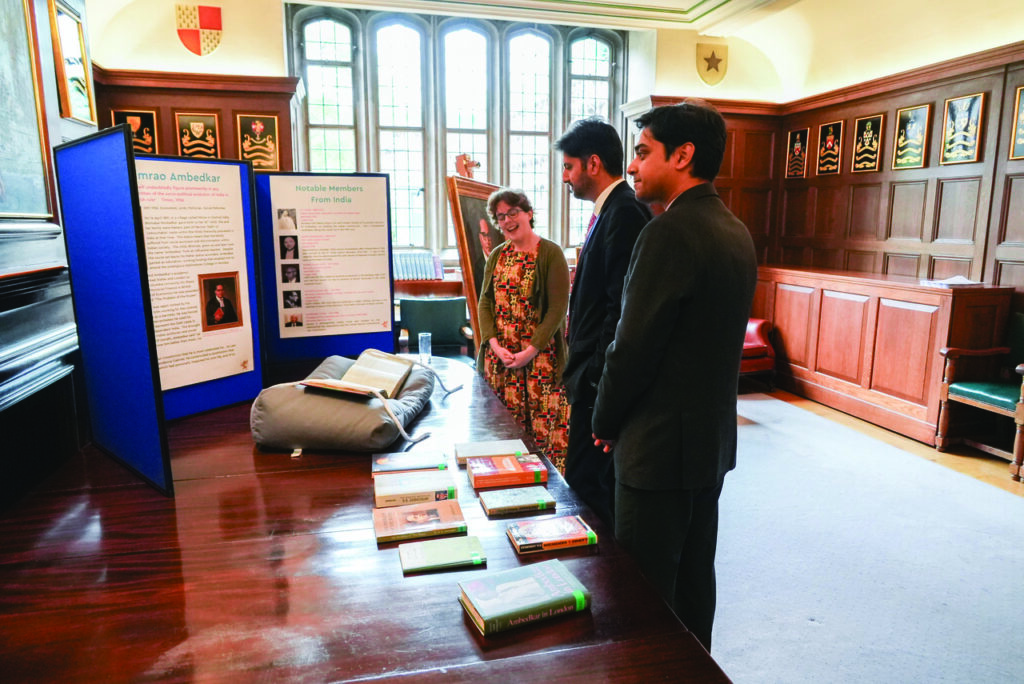
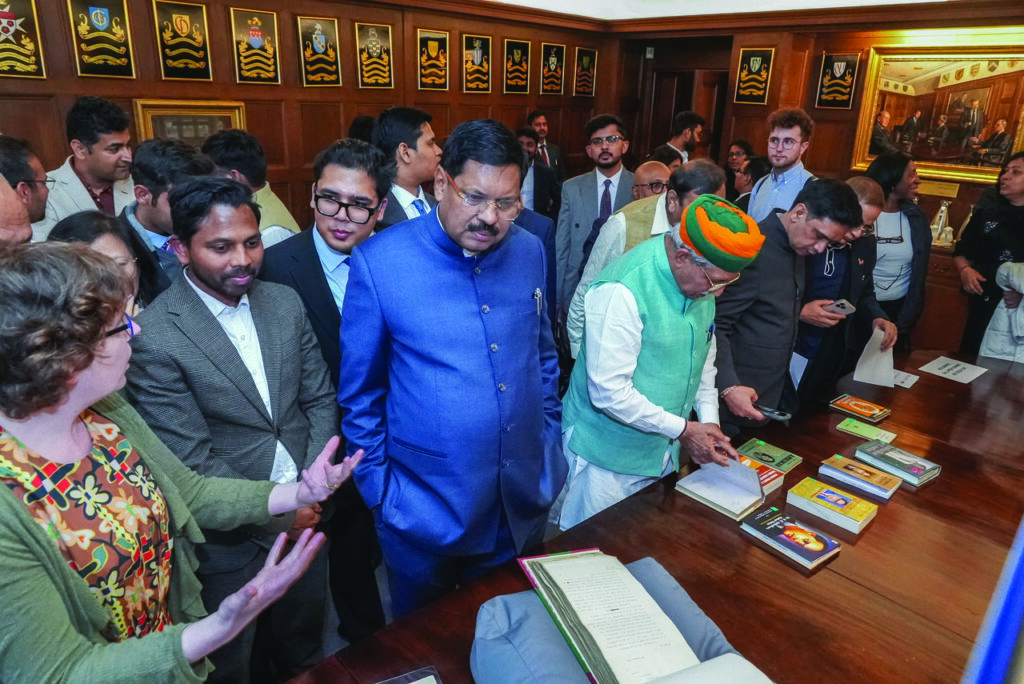
The Constitution came into force in January 1950. ‘What would India look like today (asked the High Commissioner) without Ambedkar’s Constitution that established India’s democracy?’ There lay the true significance of Dr. Ambedkar’s work and his enduring influence on India. After the speeches, everyone present in the packed Hall was invited to visit an exhibition in the Small Pension Room mounted by Katherine Gwyn (Archivist) which included the display of two fine portraits of Baba Saheb, both being an important part of the Inn’s Portrait Collection. Also on view were Ambedkar’s Admission Application and Petition to be Called to the Bar at Gray’s Inn, a Society Dr. Ambedkar had joined nearly 110 years ago.
With thanks to the High Commission India for permission to use the photographs.
Explore more from this edition
Association of Gray’s Inn Students
Take a moment to reflect on the activities of the Association of Gray’s Inn Students throughout the year, ranging from the Summer Party to the publication of the Student Law Journal, and view a photo gallery featuring some of the Inn’s Residential Scholars…
Gray’s Inn Scholarships 2025
The Inn is delighted to announce the recipients of this year’s scholarships, including awards for the Bar Course, GDL, Senior and Ann Goddard Scholarships, as well as Internship Scholarships.

History Society Lecture
Master Clive Osborne reports on Professor Patrick Diamond’s History Society lecture, “From Boris Johnson to Donald Trump: Do western democracies get the leaders they deserve?”, exploring the qualities of effective political leadership and the structural and societal reasons why many democracies produce ineffectual leaders.

My Call to the Bar
Master Richard Hawkins reflects on his early days at the Bar, from his pupillage with John Mathew in 1963, through his first criminal trial and fortunate acquittal, to working with Dick Lowry and Nina Lowry, the first woman appointed as a judge at the Old Bailey.