History Society Lecture
Number 46, Spring 2026
The Scapegoat – The Brilliant Brief Life of The Duke of Buckingham
Master Timothy Shuttleworth
On his tomb in Westminster Abbey George Villiers, first Duke of Buckingham, is described as one ‘whom Kings loved deeply’. That was certainly true of both James I and Charles I, the former having bestowed on him the highest rank in the peerage and elevated him to a station in the Councils of the State equivalent to a First Minister, causing considerable envy amongst many of his contemporaries.
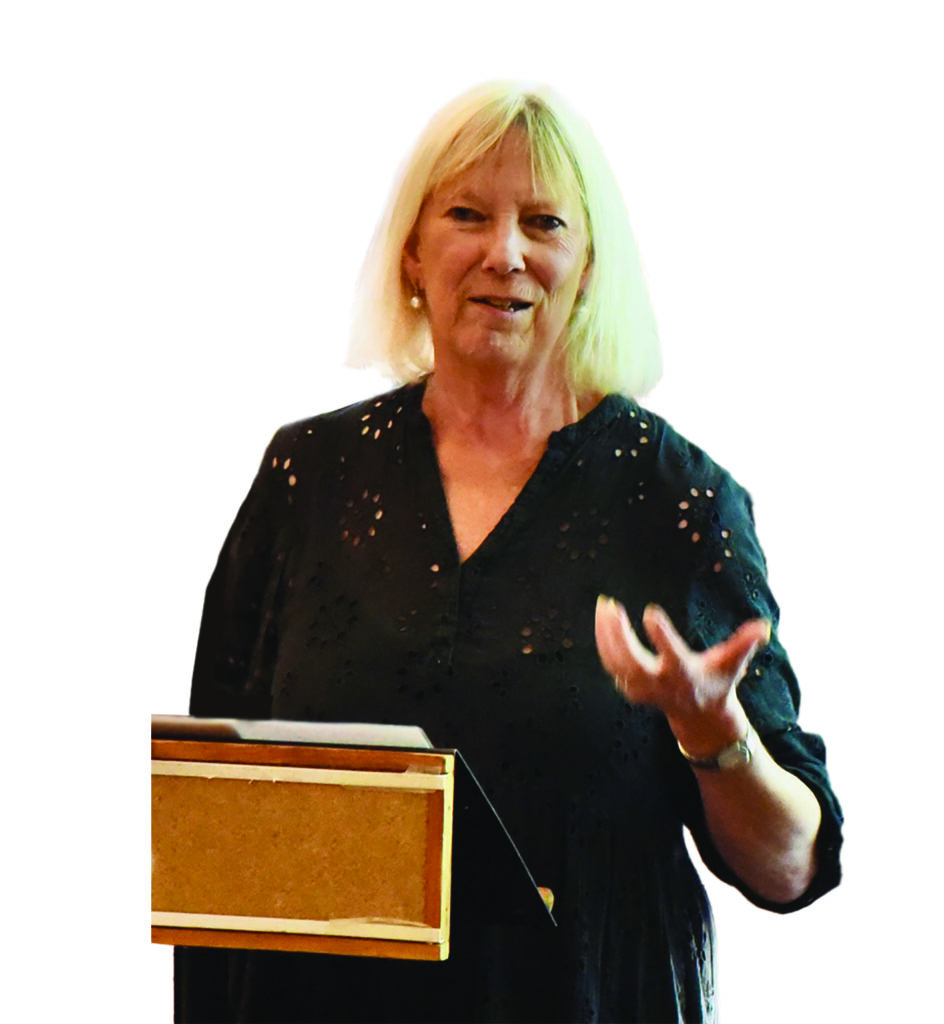
By the end of his life when he was murdered at the Greyhound Inn at Portsmouth in 1628, Buckingham had become the object of much censure and hatred too. He was nevertheless a scapegoat, as argued by the distinguished multi-award-winning cultural historian, Lucy Hughes-Hallett FRSL, in her lecture to the History Society on 25 September 2025.
Miss Hughes-Hallett’s presentation focused on Buckingham’s spectacular rise to prominence and equally sudden fall, the subject too of her latest well-reviewed biography of him entitled ‘The Scapegoat’.
Whilst admiring Buckingham’s good looks (he was called ‘one of the handsomest men in the whole world’) and celebrating him as ‘the greatest subject the country has seen’, Miss Hughes-Hallett was not starry-eyed about him. It had left her ‘uncomfortable’ (she said) that Mary Villiers (mother to George) had groomed her son to attract James I. In Miss Hughes-Hallett’s estimation George ‘was brought to Court as sexual bate’ for the King.
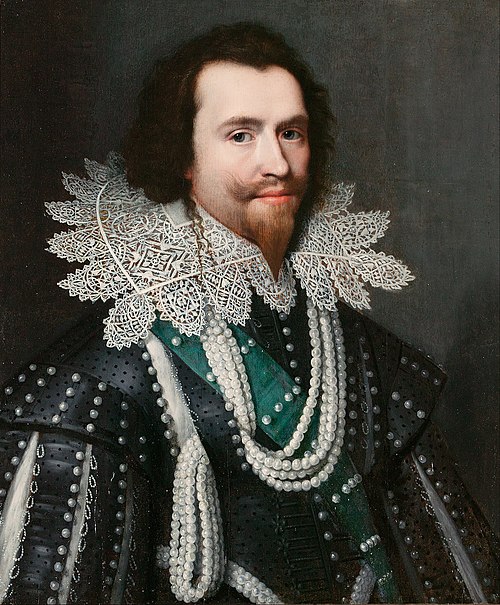
Michiel Jansz. van Mierevelt (public domain), Wikimedia Commons.
We learnt that James made little pretence of his affections for George. To the King, he was ‘my sweet child and wife … Jesus had his John and l have my George’ which Miss Hughes-Hallett interpreted (not unreasonably) as meaning: ‘If Jesus can do it, I can do it too’ i.e. to love a man.
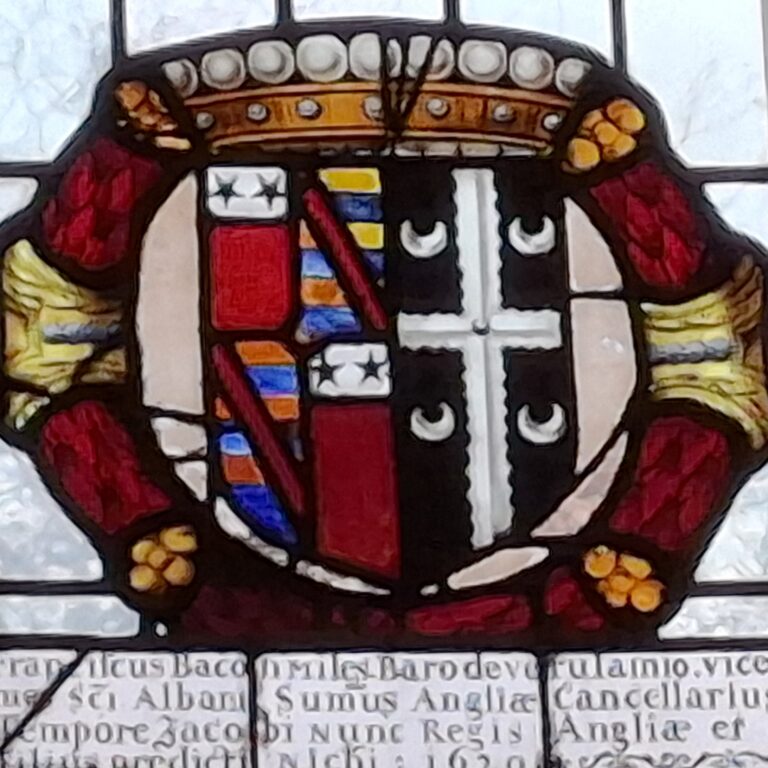
As time went on Buckingham’s position at Court grew more and more powerful and influential. Notwithstanding his closeness to the King, however, ‘being the King’s favourite is a job’ but he was not raised to the ‘job’ by dint of any sort of training. In consequence, he relied on the advice of his ultraflatterer, Sir Francis Bacon.
Bedfellow apart, James also needed Buckingham as ‘his gatekeeper’. The King hated going out in public because of his earlier experiences in Scotland, particularly as a very young boy, when he was the subject of repeated attempts to abduct him. As the King’s gatekeeper, Buckingham was the recipient of many expensive gifts (‘not just a bottle of wine(!), but loads and loads of money’, we learnt). He became very rich and spent his wealth on fine clothes, many homes and … art.
At this point Miss Hughes-Hallett treated her audience to a slide show of stunning portraits showing Buckingham either painted sitting alone wearing rich costumes, sometimes covered in strings of pearls (in commissions by Van Somer, Van Mierevelt or Rubens), or alongside his wife (Katherine Manners, daughter of the Earl of Rutland) scantily clad in poses from the classics in works of other great painters of the time, including principally Anthony Van Dyck in his famous portrayal of the couple as ‘Venus and Adonis’.
Buckingham also built up a fine collection of paintings, becoming something of a connoisseur. This was achieved with the assistance of Balthazar Gerbier, a Dutchman by birth. A portrait painter himself, Gerbier was also ‘a hustler, a dealer, a fixer, a go-between … who had a nose for a bargain’. He was the ‘creator and curator’ of Buckingham’s enviable art collection.
In 1625 James I died. By that time Buckingham had been Lord High Admiral for several years. James was a pacifist but the men of England didn’t support their King’s refusal to go to war. There was a strong public appetite for war and in the new reign Buckingham shared that sentiment. He seems to have been given his head by Charles on what wars to pursue, the King seeing himself as the younger partner. It was very much a case of a ‘younger brother’ (the King) looking up to an older brother (Buckingham).
Buckingham’s foreign adventures (the repeated failed assaults on La Rochelle) were disastrous for the country. Charles could presumably have stopped his favourite but did not. Because the public dared not to criticise the King, they turned on Buckingham. He was the ‘evil spirit that walketh between a good master and a loyal people’. In his foreign policy (it was argued): ‘Buckingham had made decisions that resulted in the deaths of thousands and the destitution and misery of thousands more. He was not a blameless sacrificial victim, but he served that function’.
As Miss Hughes-Hallett’s compelling lecture drew to its conclusion, her audience was left in no doubt that Buckingham was indeed … ‘The Scapegoat’! That leaves me to add that last December, The Sunday Times critics named ‘The Scapegoat’ one of the best non-fiction books of 2025.
Explore more from this edition
Book Reviews
Two compelling books – one exploring justice by an experienced judge in the Old Bailey with a focus on women and girls, the other, and exploration of law and science through a biography of pioneering British physicist and astronomer Sir Bernard Lovell.
Notices
Key announcements including New Benchers, New Silks, recent deaths and Notices from Pension.

From the Treasurer
Master Andrew McFarlane reflects on a lifelong bond with Gray’s Inn, from his first visit to the Inn at the age of 17, to his role as Treasurer in 2026.

Griffin at Large
A tribute to service at Gray’s Inn, Bacon 400 celebrations, and reflections on tradition, music, governance and the people contributing to the Inn across the generations.