Griffin at Large
Number 46, Spring 2026
Most Societies that survive across centuries are blessed by having the support of a small cadre of those who dedicate themselves to the institution they serve over long periods. It is that devotion by a limited number that contributes so much to the continued success and longevity of our own Inn and perhaps at times even to its survival too. To that cohort Master Keith Lawrey undoubtedly belongs and because it is well deserved it is only right that such a sentiment is expressed here on his retirement in May 2026 from the Graya Board after 50 years’ service.
Master Lawrey was called at Gray’s in 1972 and over many decades he served as Secretary to the Graya Board where his minutes were meticulously prepared with the help of his wife Jane. In meetings of the Board he rarely intervened except to remind the Chairman gently that a salient point had been overlooked thus bringing deliberations back to the matter at issue and often to a speedy conclusion.
A man of custom and convention in an era when tradition is jettisoned at our peril, he was made an Hon. Bencher in 2016 and in 2023 received a Silver Griffin from the Society. This was a unique distinction as it is normally only awarded only to non-Honorary Benchers.
Master Lawrey has served many other institutions with characteristic devotion including the Society for Radiological Protection where he was made an Honorary Fellow in 2025. The citation includes this passage: ‘Keith is passionate about the value of professional bodies to society and the importance of them being governed and regulated in the right way ‘.
Few at Gray’s Inn will be surprised by that!
Griffin wishes Master Lawrey and his wife Jane many years of happiness ahead and adds the hope that they will not absent themselves for too long, if at all, from the high days of the Inn’s Calendar, especially the annual Mulligan Sermon in Chapel, on which Master Lawrey has regularly written for our magazines, and the Treasurer’s Reception where Keith has often been responsible on numerous occasions for the Graya stall.
We have several additions to the Board, following an advertisement which attracted many applications, for all of which we are most grateful.
Master Meyric Lewis is a planning and environmental lawyer in Chambers in the Temple. Although born and brought up in London he is very proud of his Welsh heritage and therefore glad to be a member of the Bar’s most Welsh Inn. He was delighted to be elected a Bencher in 2025.
Phoebe Whitlock (called 2019) is a probationary tenant at Lamb Chambers practising in civil, technology and intellectual property law. She is a Churchill Fellow researching the use of AI in the legal profession and holds an MSc in Intellectual Property Law from the University of Oxford. Phoebe is also a lay trustee of the Royal Microscopical Society. She is also a UN Women UK delegate and an active contributor to legal education and access to justice initiatives.
Divya Kesar is a dual-qualified commercial litigator and international arbitration practitioner with over 20 years’ experience of handling complex, high-value, multi-jurisdictional disputes. She specialises in cross-border commercial and investor-state cases and practises as a barrister in London and an advocate in New Delhi, bridging legal practice between the two jurisdictions. She also has a strong academic interest, with her work published in leading journals, including Arbitration: The International Journal of Arbitration, Mediation, and Dispute Management.
We are delighted that all have contributed to this issue of Graya News.
Bacon 400 is launched
The focus of many events at Gray’s this year is the life and importance to the Society of Sir Francis Bacon (1561–1626) as the Inn marks 400 years since his death. Apart from tours of the Estate that emphasise Bacon the man and his influence on the Inn, a Sung Eucharist, music in Chapel and an exhibition, the much-anticipated Bacon Reception and Dinner on 21 May will be the key event with an address at the Dinner by Professor Alan Stewart. Professor Stewart is the co-author of a fine biography of Bacon and in addition Director of the Oxford Francis Bacon, a 20-volume edition of Bacon’s writings for Oxford University Press. During the evening there will be music , short readings from Bacon’s works, possibly an ‘essay’ delivered by a multiple BAFTA, Olivier and Tony award winning actor and noted Bacon enthusiast (theatrical commitments permitting) and other entertainment, all starting in the Walks.
The public tours are the responsibility of Sam Hutchinson, Chief of Staff, who manages the events and acts as guide on many of the tours or, in his absence, the Residential Scholars will assist. The first tour took place on 20 February and proved a considerable success.
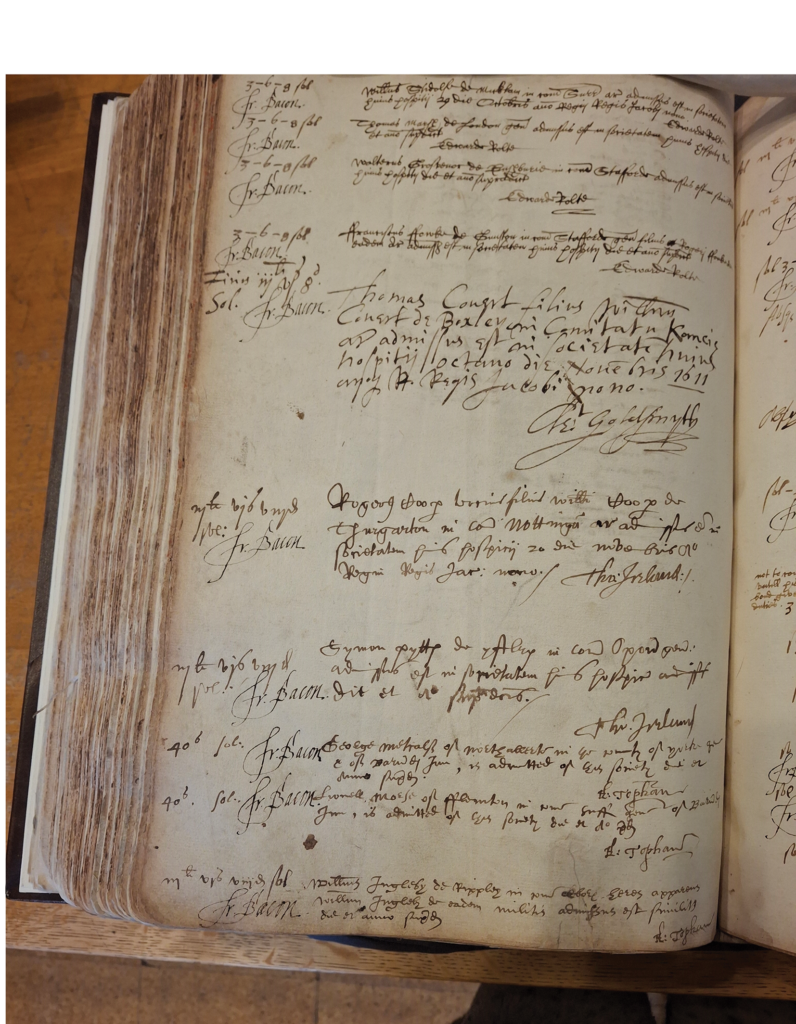
There is an exhibition at the initiative and creation of our Archivist, Katherine Gwyn. It tells the story of Bacon and showcases some of the Inn’s collection of antique editions of Bacon’s works. During the public tours it also includes some of the Inn’s oldest documents, some of which are written in Bacon’s hand. The exhibition continues in the Library until the end of June and may be viewed by everyone at the Inn during Library opening times. The Inn is indebted to both Sam and Katherine for their work in this busy year.
The Bacon’s society generous loan
From early January, members will have noticed a new portrait of Bacon (new to the Inn that is) on the east wall in Hall and shown on the front cover. It has been hung beneath the familiar image of Queen Bess who in 1597 conferred on Bacon the first award of the distinction of Queen’s Counsel. Subsequently Bacon was to prosper to an even greater extent under James I as Attorney General and Lord Chancellor before his downfall. The artist (sadly unknown, as is the date of the work) provides a sensitive image of Bacon. What is particularly convincing about the portrait, and nicely limned, is the shape of Bacon’s lower eyelids which appear to fall away from the eye, typical of a condition known as ectropion, a common result of the aging process that may be corrected by a minor operation today. So the portrait is best seen close up and admired for its considerable naturalism.
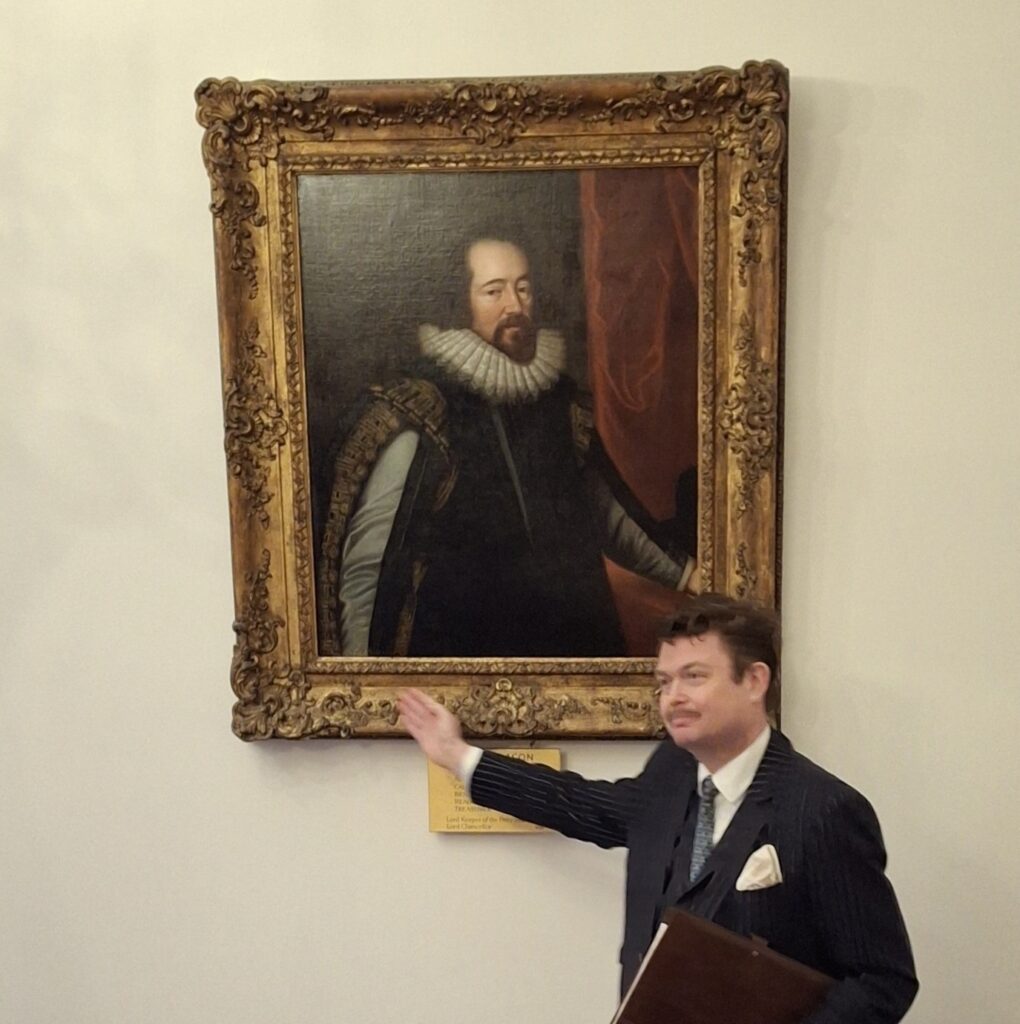
The portrait is on loan from the Francis Bacon Society for three years to whom the Inn is deeply grateful for such a remarkable unselfish gesture. Lately the Bacon Society has generously arranged for a restoration of the portrait giving to the work its colour and vibrancy which compounds the Inn’s feelings of obligation.
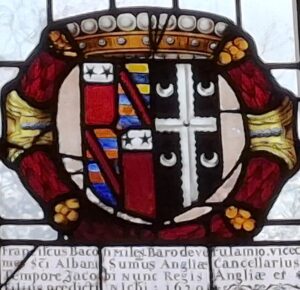
Arms of Sir Francis Bacon
Even more recently Griffin has heard from Sally Gibbins, Principal of the Francis Bacon Society, who expressed her appreciation of how beautifully the portrait was displayed in Hall adding her ‘heartfelt gratitude to everyone at Gray’s Inn who made it possible to bring Francis back to his rightful home’.
As will be well known to many, the Inn owns two fine portraits of Bacon. One is located on the Bench staircase and is attributed to the ’Circle of Paulus van Somer’ meaning the portrait was painted in the same era of van Somer (1577–1621) and heavily influenced by his style. The other hangs in the Under Treasurer’s office. It is a fine three-quarter length image and is given the attribution ‘After Paulus van Somer’. That can often mean that it is a copy that may have been made by a pupil or apprentice of the artist, and possibly under the artist’s direction.
Deferred Call
The vexed question of deferring Call to a time when the callee has completed the non-practising period of pupillage has recently preoccupied the Bar Council, COIC, and several working parties at the Inns to name but a few.
For many in the profession there has long remained a strong perception, no more, that there was a large cohort of non-practising barristers bestriding the business world and other fields who were misrepresenting themselves to prospective employers and the public generally as fully qualified barristers (when they were not) or did little to correct any such misapprehension. This mischief alone, it was believed, was putting the reputation of the profession at risk as well as giving rise to confusion amongst the public.
From the report of the Gray’s Inn Working Group and other submissions, there appears to be little evidence, if any, that the public are confused about the current situation or that the profession is suffering any reputational damage from the growing number that have been called ‘though not chosen’, so to speak, for pupillage. If that is so, then is the position in the profession any different from medical students completing their medical degree at Medical School (and gaining the award of MBBS or MBChB) when they are indeed entitled thereafter to call themselves ‘doctor’ once provisional registration with the GMC has been obtained? At that point, a doctor is still under supervision and training. Until a doctor has completed training and is registered to practise as such with the GMC, he or she is under a duty to ensure that the limit of their experience is made clear whenever they use the title of Doctor whether in personal contact, in writing or online. That same duty is similarly placed on Barristers who have been ‘called to the degree of Utter Barrister’ on Call Night until they have successfully completed the non-practising period of pupillage. There is little evidence that any breach of this obligation manifests as a major issue. Since previous concerns would seem to be misconceived, certainly in this regard, and it has been shown that the qualification of barrister, standing alone, carries sufficient prestige to open doors for those unfortunate in their search for pupillage, why pull up this ladder of opportunity?
Choral Mattins for epiphany
Only a few years ago, those attending Chapel on Sundays would often be treated to the virtuoso skills of Master Damian Falkowski (on violin) and his young daughter Clara Falkowska (on trumpet) as part of the Mattins service. At the Choral Mattins for Epiphany on 18 January, the congregation was reminded of those previous moving occasions by Master Ian Wilson (on organ) and his young son Lucas Wilson (on trumpet) playing the Trumpet Voluntary (Jeremiah Clarke and Henry Purcell). How blessed those in the congregation were at this first Chapel service of the year and how fortunate the Inn is to be able to call upon such contributors and to have as our Director of Music, Master Christopher Bowers Broadbent. The service took place close to the tenth anniversary of the death of David Bowie and this was occasion enough for the Rev. Baxter, our Chaplain and known David Bowie enthusiast, to reference Bowie. In his sermon, the Preacher spoke of Bowie’s fascination with Christianity, often referenced in his works. At one time Bowie was quoted as saying he had ‘an undying belief in the existence of God’. Whether that belief was sustained to the end is probably doubtful, but Bowie was certainly engaged in a life-long spiritual quest.

Photo by Roger Woolman, CC BY 3.0 via Wikimedia Commons, cropped
Griffin cannot conclude without mentioning the musical skills of Master Geraldine Andrews (Treasurer last year) who has added to her virtuoso violin playing at many events at the Inn over the years the considerable gift of also arranging music. This was amply demonstrated by Master Andrews with her impressive setting of Nativity Lullaby (words based on a medieval text) at the Service of Nine Lessons and Carols in Chapel on Sunday 14 December. The service drew a packed congregation to the Chapel that even saw some driven by the crush to sit on the stairs leading to the west gallery.
Explore more from this edition
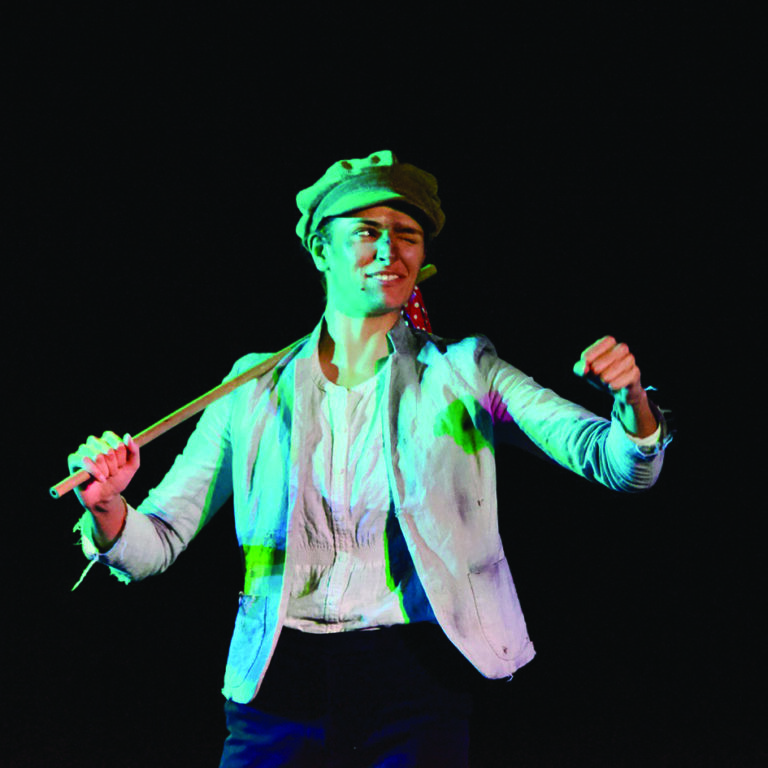
Gray’s Expectations or What the Dickens!
Dickens, music and mayhem collide as Gray’s Inn transforms Victorian fiction into a riotous, song-filled Miscellany.
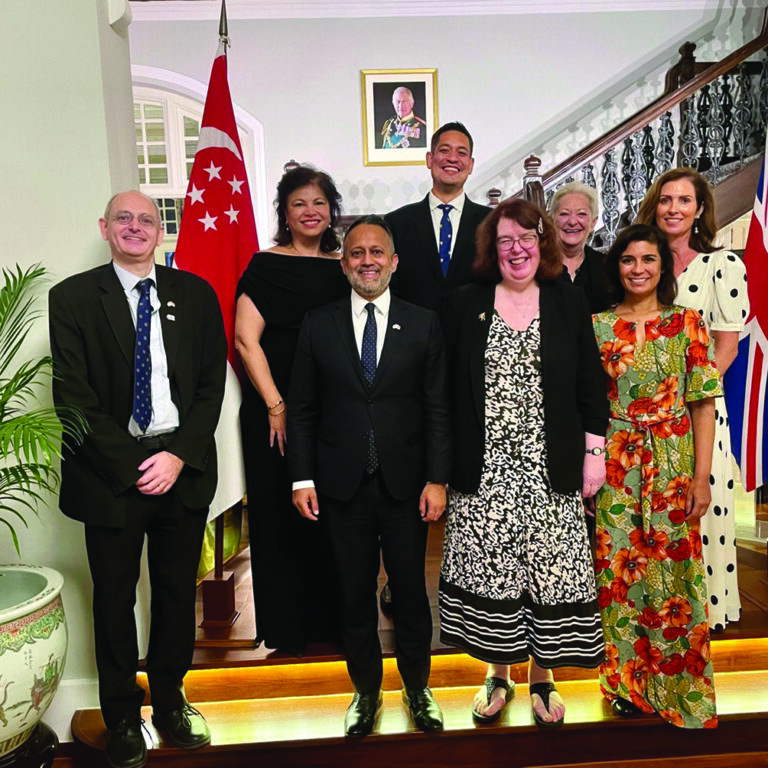
Treasurer’s Amity Visit to Singapore and Malaysia 2025
Our enduring bond with Singapore and Malaysia unfolds through training, diplomacy and friendship, culminating in the Inn’s amity visit in September 2025.
Interrogatories Answered by the Treasurer
From theatre dreams to family justice, our 2026 Treasurer, Master Andrew McFarlane, reflects on vocation, public duty and life beyond the law in a candid interview.
Popular Myths at Gray’s Inn: The Night of Errors Part 2
Master Timothy Shuttleworth challenges the belief that The Comedy of Errors was first staged against the Hall screen, arguing – using Gesta Grayorum and later research – that the performance likely took place near the dais.