Book Reviews
Number 46, Spring 2026
Rough Justice by Master Wendy Joseph
Review by Master Rosemary Jeffreys
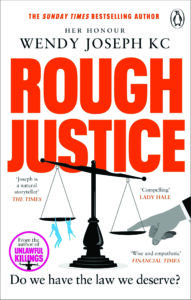
Master Wendy Joseph has given us another excellent book, which follows a similar pattern to her previous work, Unlawful Killings, but this time focussing on women and girls. She gives us an insight into the thinking of an experienced judge in the Old Bailey, and, through this, an aperçu of why criminal law can be so fascinating, suggesting it is because it is all about stories and about people. She introduces us to four defendants in this book, which is divided into four parts. As in her previous book, Master Joseph has combined facts from different trials and changed the names for the sake of anonymity. Each part presents a defendant with whom we can sympathise and a compelling narrative. I found it difficult to put the book down. She links each modern story with one from the past, which she found by accessing the records of the Old Bailey itself, and asks herself what we have learned in the intervening period, in particular about how to treat fragile defendants and witnesses. The discussions over tea and lunch with other judges help to resolve some of the difficult situations.
In the first part, ‘The Evil that Men Do’, we read about a defendant charged with molesting a child, with the prosecution facing the difficulty that no contemporaneous complaint was made. In the second, ‘The Way to Dusty Death’, a 15 year-old child made unwise contact with a drugs gang, some of whom appeared to be present in the public gallery for part of the trial. She was charged with murder of an elderly lady, dismemberment of the body and disposal of the body parts. At the suggestion of the judge, the third is put into a separate count, to which she pleaded guilty. Master Joseph also found a way of dealing with some of those in the public gallery. The junior defence counsel, who was absent at the beginning of the trial, conducts a skilful defence on the first two counts. In the third part, ‘The Quality of Mercy’ we learn about ‘battered woman syndrome’ and what can lead a woman who had been married for 20 years to kill her husband. In some ways this is the most difficult case of all, but a possible defence of diminished responsibility emerges, following posttraumatic stress disorder. In the fourth, we learn about a young boy who was blinded when attempting to use a sawn-off shotgun found in his grandmother’s home. His father and grandmother (who has dodgy legs) are charged. The members of the jury are the heroes of this story, but counsel gain admiration too, behaving with surprising humanity.
Master Joseph raises important questions as to whether we do all have equal access to the law and the courts and whether we are all treated equally and is to be congratulated on another thoughtful and beautifully written book. It is something which I would not have read had I not read ‘Unlawful Killings’, and would indeed have been the poorer had I not done so. Although I felt that the outcome in the four cases discussed was fair, it is clear that the system, even though better than it was 200 years ago, is far from perfect.
Space has no Frontier: Terrestrial Life and Times Of Sir Bernard Lovell by John Bromley-Davenport
Review by Master Christopher Butcher
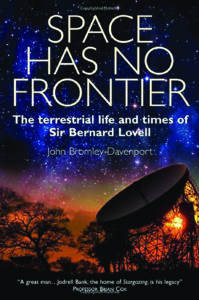
Sir Bernard Lovell’s great project, a radio telescope at Jodrell Bank, celebrated its 80th birthday in December 2025. It was marked, amongst other things, by a haunting new composition – Pulsar – by Hannah Peel for the BBC Philharmonic Orchestra. To mark the occasion, it seems appropriate also to include a notice of John Bromley- Davenport’s biography of Lovell, which was first published in 2013.
John Bromley-Davenport, a member of Hall, first met Lovell in 1995 and knew him for the last seventeen years of his life. This book reflects its author’s affection and admiration for the man Patrick Moore described as ‘the Isaac Newton of radio astronomy.’ It charts Lovell’s childhood in a religious, and music- and cricket-loving family, in Oldland Common near Bristol; his career as undergraduate and graduate at Bristol University; and then his transfer to an assistant lectureship at Manchester University. Soon after his arrival there, Lovell’s great hero, Patrick Blackett – later Lord Blackett and a Nobel Prize Winner – arrived to be head of the physics department. With the outbreak of World War II imminent, Blackett arranged for Lovell to work with the Air Ministry on the development and application of radar, and it was in this field that he spent the war, making a significant contribution to the improvement of radar, and its adaptation to various defensive and offensive uses, including in particular ‘H2S’, which facilitated navigation and bombing when aircraft were ‘blind’ because of darkness or weather conditions.
After the war, Lovell returned to Manchester, and began research seeking to use radio echoes to detect cosmic rays. It soon became apparent that, in the centre of Manchester, there was too much interference with the radio waves from sources of electricity, such as the tram network. The Head of Botany revealed that his department had some fields which they used as a nursery, some 20 miles south of Manchester, in the heart of the Cheshire plain, at a place called Jodrell Bank. There, Lovell sited aerials with which, on 14 December 1945, he started observations. Little progress was made in relation to the detection of cosmic rays, but very soon there were interesting observations in relation to meteors. As Bromley-Davenport puts it, ‘almost without realising it, [Lovell] had become an astronomer.’
By the end of 1948, Lovell had formed a plan to erect a very large, fully steerable, paraboloid. In February 1950 a committee of the Royal Astronomical Society unanimously endorsed the project. And so began the process of designing and constructing what became the Lovell telescope at Jodrell Bank. This process was embarked on without any proper cost budgeting or a plan for how the amount which it would actually cost could be raised. It is a testament to Lovell’s enthusiasm and will-power that it was built at all. Ultimately, the financial difficulties were eased by a piece of good fortune: in October 1957, in full view of the press, the telescope was able to track the course of the carrier rocket of Sputnik I. This changed the public’s and the government’s perception of the value of the telescope. In the following years, the telescope played its part in the cold war, as an instrument capable of detecting and tracking ICBMs, and in the space race, during which, for example, the telescope detected the crash of the Russian unmanned spacecraft, Lunik 15, onto the surface of the moon. The Russians had sent Lunik 15 to the moon at the same time as Apollo 11, apparently aiming to steal at least some of the Americans’ thunder. The telescope showed how completely this failed.
So significant had Lovell’s work become that, in 1963, an attempt was apparently made by the Soviet authorities, during a visit he paid to Russia and Armenia, to persuade him to defect. It may also be that, upon his refusal, they tried to poison him. Certainly, on his return from this trip, he was extremely ill; and he himself firmly believed that the Russians had attempted to poison him with radioactive material, perhaps to remove his memory of the things he had seen, or even to kill him.
As John Bromley-Davenport stresses, Lovell was not just a pioneering scientist: he was a man of wide interests and talents. He retained, throughout his life, a great interest in music, especially for the keyboard. For forty years he was the organist of the church of Swettenham, until he could no longer see the music. He presided over the planting of an extensive arboretum, which came to contain thousands of different types of tree. His much-praised Reith Lectures in 1958 reflected on the role of faith in the mentality of both scientist and religious believer.
John Bromley-Davenport successfully captures the character and spirit of his subject. Scientific concepts are described with simplicity and lucidity. The book is a fitting tribute to an exceptional man and his remarkable legacy.
John Bromley-Davenport has kindly said that anyone wanting to buy a copy of the book should email him at brommersqc@btinternet.com. The price is £20.
Explore more from this edition
Notices
Key announcements including New Benchers, New Silks, recent deaths and Notices from Pension.

From the Treasurer
Master Andrew McFarlane reflects on a lifelong bond with Gray’s Inn, from his first visit to the Inn at the age of 17, to his role as Treasurer in 2026.

Griffin at Large
A tribute to service at Gray’s Inn, Bacon 400 celebrations, and reflections on tradition, music, governance and the people contributing to the Inn across the generations.
Gray’s Expectations or What the Dickens!
Dickens, music and mayhem collide as Gray’s Inn transforms Victorian fiction into a riotous, song-filled Miscellany.