Griffins in the Inn
Number 46, Spring 2026
Master Stephen Irwin
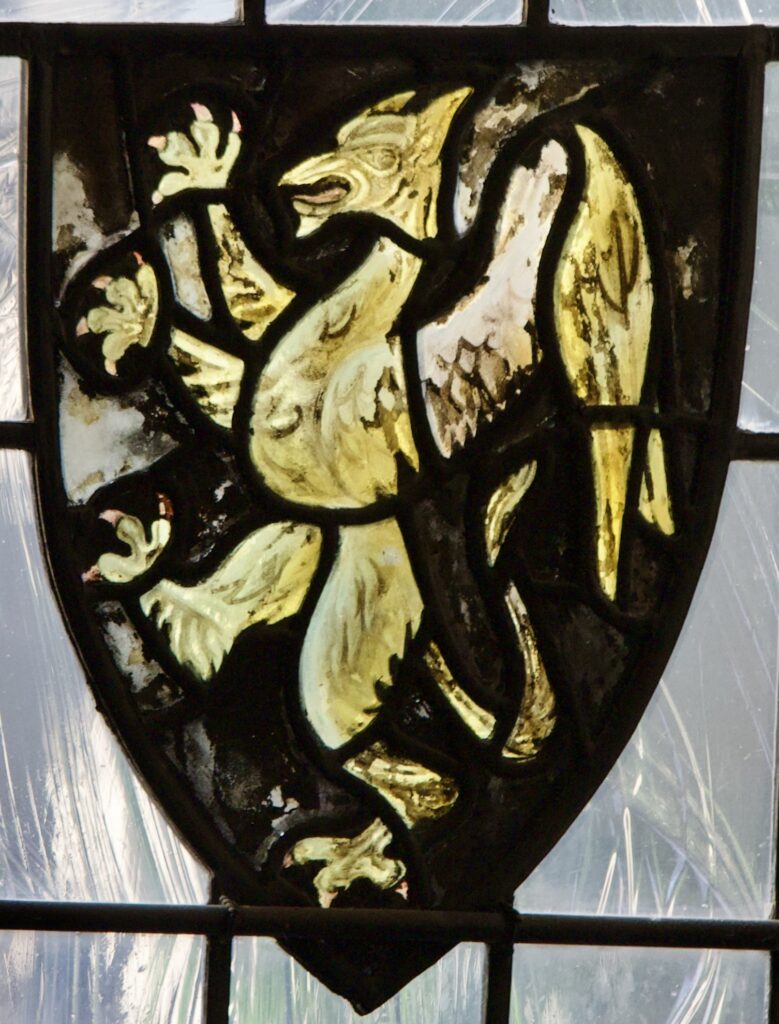
Griffins are rampant in Gray’s Inn. You can see them everywhere on the buildings, you can buy a somewhat sombre tie spotted with them, they appear on the stationery, they are embossed on the Gray’s Inn diaries. A Bencher who survives fifty years from Call may be lucky enough to be presented with a little silver griffin. In Graya and Graya News, Griffin (in truth Griffins) enlarges and occasionally growls on the topics of the day. But what are griffins? Where do they originate? What are their powers and attributes? Are they benign or should we be fearful of them? And how did we come to have the Griffin as our symbol?
To answer the last question first, if you consult the Illustrated History of the Inn (p. 41) the golden Griffin on a black ground was adopted by the Inn as its badge in about 1590 but it is not known why. Without more, it might simply be thought that the Inn wanted to garner more of the glamour of an armorial badge. The 1590s was a period when the Inn’s prestige was at a zenith. Elizabeth I was on the throne, her chief ministers – Lord Burghley, Sir Nicholas Bacon, Walsingham, and then Burghley’s son Robert Cecil – had been or were leading members of the Inn. Although warfare had moved on from the time when mounted knights in plate armour represented the ultimate in heavy battle force, the signs and symbols of chivalry were immensely popular. The young Earl of Essex rose into huge favour with the Queen in the late 1580s in part because of his exploits in the Royal tiltyard at Westminster.
Internet research suggests that the Lion Rampant of Lincoln’s Inn is derived from the arms of Henry de Lacy, third Earl of Lincoln, from whom it is thought the Inn takes its name. Inner Temple acquired a grant of arms adopting the Pegasus in 1561, and in 1597 the Middle Temple were granted their arms, picturing the Lamb of God carrying the banner of St George. So heraldic symbols were important.
However, our learned Master Timothy Shuttleworth has advanced a more specific and fascinating explanation for the adoption of the Griffin: see Graya News No 35 (2020). Master Shuttleworth observes that until the 1590s, the Inn used the family arms of the de Greys of Wilton consisting of three white bars alternating with azure, lying across a shield. From the early 14th century until the 1590s, the de Grey family owned the Manor of Purpoole, in which stands the Inn. The title and the estate were inherited in 1593 by Thomas Grey, the 15th baron. These arms may now be seen in the portico above the Benchers’ entrance from South Square.
Although Thomas Grey helped to suppress the rebellion of the Earl of Essex at the end of Elizabeth’s reign, he himself came to grief soon after the accession of James I and VI. Grey was what was then becoming termed a Puritan. He was seemingly involved in the ‘Bye Plot’, a plan to capture the new king and force him to permit religious tolerance. Grey was tried and convicted of treason, and sentenced to death, but was reprieved by the King literally on the scaffold on 10 December 1603. He was returned to the Tower, where he remained until his death. His lands were forfeit and his honours and titles suppressed.
This association must have been hugely difficult for the Inn. Sir Robert Cecil had been instrumental in securing the succession of King James to the throne. He had been in clandestine contact with James before his English accession. He was positioned to become the chief minister to the new king, as he had been to Queen Elizabeth after the death of his father Lord Burghley. In addition, Sir Francis Bacon, recently knighted by the new king, and full of ambition to succeed to great office, advancement which had eluded him during the reign of the old Queen, would have been anxious to avoid connection with such a plotter.
There is no mention of any decision as to such a change of emblem in the Pension Book. Only two entries might give a clue, although each is equivocal. In the Pension of July 1595, it was ordered that £6 ‘claimed by one Mr Segar the Quen’s servant for nyne shields & their emprisses be discharged in part of payment.’ The Mr Segar in question is identified as the Somerset Herald and Norroy King-at-Arms. Clearly these were heraldic decorative shields. The de Grey arms were comprised in a shield, where the Griffin is usually presented in a roundel. Then, at the Pension of 26 January 1604, the first after de Grey’s trial, the Benchers recorded as first business an item demonstrating that the new king was taking a close interest in who was admitted to the Inn: ‘Att this penčon the kings commaundment was signified delivered by the Judges that none shall hereafter bee admitted into this Societie unless he bee a gentleman by descent until his majesties pleasure bee further knowne’. Clearly the Royal gaze was on the Inn.
It can at least be said that these entries are consistent with the change of emblem at the time and for the reason proposed by Master Shuttleworth.
Why a Griffin? As Master Shuttleworth reminds us, the late Master Richard Stone in his Gray’s Inn: a Short History (1997) suggested that the Griffin was probably adopted from the arms of Master Richard Aungier, a very senior and distinguished Bencher of that time. It may also have appealed to the theatrically inclined or ‘Masque-minded’ in the Inn, who would realise that it was a much more striking image than the rather neutral blue and white bars of the de Grey arms.
What is a Griffin?
But what is a griffin? Sir Thomas Browne was a great prose writer of the 17th century. Part of his business as a writer was to put down the urban myths and fake news of his day. He described the griffin as ‘a mixed and dubious animal, in the forepart resembling an eagle, and behind the shape of a lion, with erected ears, four feet, and a long tail’. Browne traces the origin back to classical sources and to ‘an hieroglyphic of the Egyptians’. At a time when many believed in the literal existence of such creatures, he is scathing about the notion. They are fancies only:
‘the Hieroglyphical authority, although it neerest approach the truth, it doth not inferre its existency. The conceit of the Griffin, properly taken, being but a symbolicall phancy, in so intolerable a shape including morality. So doth it well make out the properties of a Guardian, or any person entrusted; the ears implying attention – the wings, celerity of execution – the Lion-like shape, courage and audacity – the hooked bill, reservance and tenacity. It is also an Embleme of valour and magnanimity, as being compounded of the Eagle and the Lion, the noblest animals in their kinds..’ Pseudodoxia Epidemica or Enquiries into very many received Tenents and commonly presumed Truths: Browne (1646)
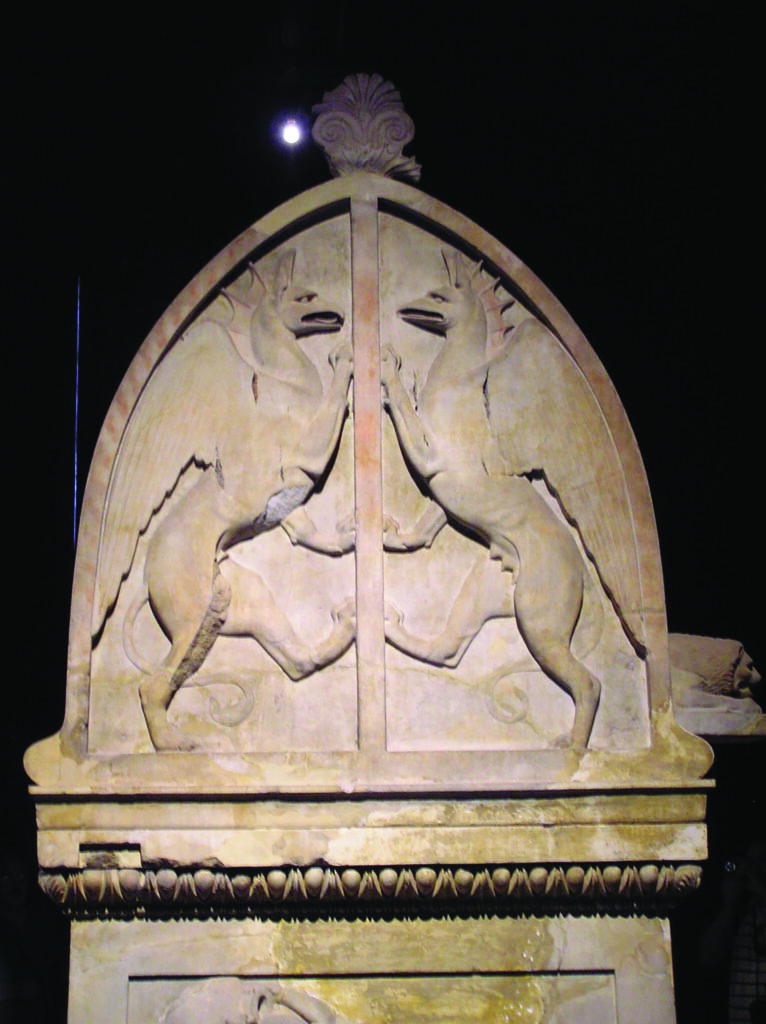
The griffin certainly appeared in some imagery of classical times. Here is a rather lovely example dating to 430–420 BCE, from the Royal Necropolis of Sidon, a city now in the Lebanon, which today can be seen in the Archaeology Museum in Istanbul.
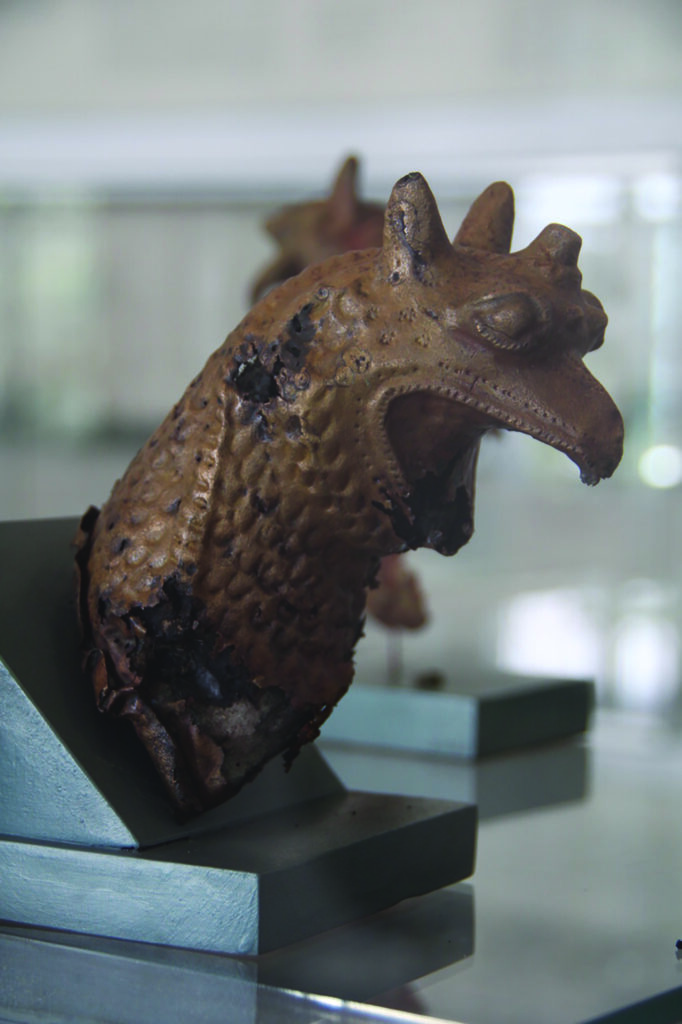
However, the griffin is a far older beast than that. Between the eighth and sixth centuries BCE, the griffin was the key decorative motif on bronze bowls or cauldrons, found around the Mediterranean. Aristeas of Prokonnesos, a seventh century mystic and poet from a Greek island in the sea of Marmora, places the griffin’s habitat near the land of the Hyperboreans, the winter retreat of Apollo. The griffins were guards (of gold) whose vision was legendary. Griffin cauldrons were associated with temples or sanctuaries and the images of griffins cast or incised in bronze bore ‘an unwavering cultivation of lifelikeness, attention to characteristic detail, and not least the sophisticated crafting of the griffins’ eyesight’ (Papandreou 2021, Bronze Monsters and the Culture of Wonder, p. 226). The word griffin is derived from the Greek word gryps, meaning hooked (referring to their beaks). Once the phase of manufacture of such cauldrons ended around the sixth century BCE, the griffin image faded and became less prevalent during classical times.
There is also scholarship suggesting how such imagery may have arisen in the Mediterranean region. In her book The First Fossil Hunters (Princeton 2000), Adrienne Mayor recounts her first visit to Samos, the Greek island just off the Turkish coast, pursuing her idea that the images of griffins might be drawn from the remains of unfamiliar extinct animals. She visited the museum and found a trove of bronze griffins retrieved from the ruins of the sanctuary of the goddess Hera. Excited by her finds, Ms Mayor rushes out of the museum and down to the quay, where she hires a motorcycle, and hares off up a switchback road to the village of Mytilini. The museum there contains the skull of the Samotherium major, an extinct animal from the giraffe family. The Samotherium had a range including Greece, Turkey and modern Romania, but in all honesty it bore little likeness to a griffin. Mayor therefore pursued the idea further east, to where the Saka-Scythians roamed at the base of the Altai mountains. Scythian nomads came into contact with the Greeks much further west, near the Black Sea. These people had told Aristeas that in their hinterland gold was defended by fierce ‘griffins’, who were lion-sized predators with strong, wickedly-curved beaks like those of eagles. Mayor comes up with the attractive idea that the eastern Saka-Scythians had found remains of bird-like dinosaurs in the Gobi desert, admirably preserved in the dry climate. They could not of course fly, but had four legs and laid their eggs on the ground in the desert. The skeleton of one of these dinosaurs, the Protoceratops, when placed in a standing position, bears a remarkable resemblance to a griffin, with a sharp beak, a raised front leg and a long tail. The story about the ‘griffins’ guarding the gold found in the mountains may have been invented to deter treasure seekers. An image on a red-figure vase from the fourth century BCE shows a mounted spearman attacking a griffin, with what Mayor suggests is a nugget of gold floating rather mysteriously behind the head and above the wings of the griffin (p.31). Could therefore the images and ideas have their ultimate origin in the remains of extinct dinosaurs scattered over this part of Asia?
Enough perhaps, to whet the appetite of those tempted by Griffomania. But set aside escaping a dangerous political association, honouring an elderly distinguished lawyer, or providing an exciting image for the Masque, all this might suggest that those who chose the eagle-eyed, undefeatable, guardian of gold to be the heraldic badge of the Inn, had an instinct for the apt.
With thanks to Master Shuttleworth and to the Editor for their scholarship.
Explore more from this edition
A conversation with Master Harry Carter
Master Harry Carter reflects on a public‑service career spanning EU law, the Home Office and No.10, sharing key moments, Prime Ministerial insights and his commitment to improving legislation as a crossbench peer.

The Employed Bar: Many Paths, One Profession
A panel highlighted the Employed Bar’s diverse careers, showing how practitioners across government, private practice and the armed forces find intellectual challenge, purpose and impact in flexible, service‑driven employed practice.
Is it Time for an Ethical Reset in the Legal Profession?
Professor Richard Moorhead highlighted cultural and ethical failings in the profession, with panelists stressing competence over rule changes and warning that restoring weakened professional integrity is far harder than protecting it.

Black History Month Panel Event: Black Silk October 2025
Black History Month’s Black Silk at Gray’s Inn honoured Black excellence at the Bar, celebrating inspiring advocates and KCs whose journeys emphasised authenticity, persistence, progress and the power of community.