Book Review: Unceasing War on Poverty
Number 45, Autumn 2025
Beatrice and Sidney Webb and their world: Michael Ward (Conrad Press: 2024)
Master Christopher Butcher
If one thinks of Sidney Webb, it is almost certainly as writer, social scientist or politician and not as a lawyer. Yet he called himself ‘Sidney Webb LL.B., Barrister at Law’, and he was a member of this Inn. As traced by Master Ross Cranston in his article on Sidney Webb and Gray’s Inn in Graya 127, he was admitted by Gray’s Inn in October 1882, awarded the Bacon Scholarship in 1883 and called to the Bar in 1885.
Plenty has been written about him, and about his remarkable collaboration with Beatrice Potter. Michael Ward, in his Preface to the book, recognises that it is fair to ask: ‘why a new life of the Webbs?’ The overriding reason which he gives is that the world has changed since earlier biographies were written. He says that there needs to be a re-evaluation of the ‘simplistic verdict’ on the Webbs, namely that they had one great achievement, their role in the formation of Britain’s welfare state; and made one great error, their uncritical attitude to the Soviet Union in the 1930s. What this book aims to do, the author says, is to examine their lives as a whole, looking at the families, backgrounds, relationships and friendships which shaped them, and the institutions they helped to establish.
The book considers both Webbs, but it is obvious from its contents that the author found it difficult to keep a balance of biographical interest between them. At almost all points, Beatrice is in the limelight, standing out and doing the noticeable thing, while Sidney is in comparative shadow. She went out of the ordinary confines of her class, although following a vogue of the time, by working as a rent collector in a block of working-class buildings in Whitechapel, and also as a jobbing tailoress in the Mile End Road. He, meanwhile, worked as a civil servant in the Colonial Office. She was tall and beautiful; he was physically undistinguished, short and increasingly stout. As she wrote in her diary, reflecting on her forthcoming marriage: ‘The world will wonder. On the face of it, it seems an extraordinary end to the once brilliant Beatrice Potter … to marry an ugly little man with no social position and less means, whose only recommendation, so some may say, is a certain pushing ability.’
This quotation highlights another difficulty in keeping a balance. Beatrice kept a detailed diary from 1873 until her death; and she used this for the purposes of writing her autobiographical My Apprenticeship. Any study of the lives of the Webbs is bound to rely heavily on those sources, and Michael Ward’s does. Beatrice’s voice is thus heard very distinctly. Sidney, though he was the scribe of the partnership when it came to their joint publications, did not leave nearly as extensive or revealing a personal record. His reactions, observations and assessments of people are less in evidence.
Sidney, in particular, played a significant role in the early years of the Fabian Society, and in the foundation of the London School of Economics and the New Statesman. Their work on trade unions and then on local government was ground-breaking. Sidney’s term as chairman of the Technical Education Board of the LCC allowed him to reshape London education, creating a ‘scholarship ladder’ for bright but poor children. Beatrice’s work on the Poor Law Commission, and her agitation to abolish the old poor law and replace it with specialist departments (for the sick, disabled and aged) in local authorities presaged the national health service and other aspects of the welfare state. Sidney’s 1918 Labour and the New Social Order has been seen as the basis of Labour Party policy for the following 30 years.
Michael Ward does not seek to minimise or condone the Webbs’ serious lapse of critical standards and of judgment in relation to the Soviet Union. He explains this lapse by the Webbs’ disillusion following the collapse of the second Labour government in 1931. They had, he says, somewhat lost confidence in what had been an article of their creed: the inevitability of a gradual movement to socialism. Their championship of the Soviet Union left them distraught when the Ribbentrop-Molotov pact was agreed in 1939 but Beatrice was heartened, in her last months, by the successes of the Red Army at Stalingrad. They did not live to see the deepening Cold War and the damage to their reputations caused by the full revelation of Stalin’s terror.
This book is not an academic analysis of the Webbs’ thought, actions or influence. It has textual blemishes but is generally balanced. It succeeds in its aim of putting the Webbs into the context of those with whom they interacted. While the reader is left unsure whether, as Clement Attlee claimed, they had actually done more than any others of their generation to change ‘for the better the conditions of the masses of the people’, what appears clear is that no one of their generation had tried harder to do so.
Explore more from this edition
Association of Gray’s Inn Students
Take a moment to reflect on the activities of the Association of Gray’s Inn Students throughout the year, ranging from the Summer Party to the publication of the Student Law Journal, and view a photo gallery featuring some of the Inn’s Residential Scholars…
Gray’s Inn Scholarships 2025
The Inn is delighted to announce the recipients of this year’s scholarships, including awards for the Bar Course, GDL, Senior and Ann Goddard Scholarships, as well as Internship Scholarships.

Inn & About
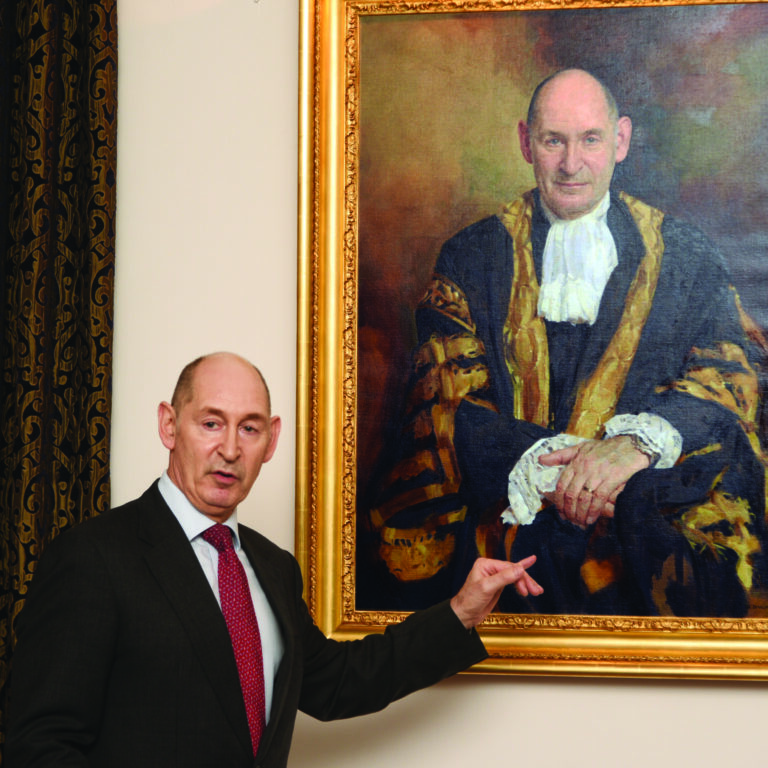
Gray’s Inn has received a new portrait of Lord Slynn of Hadley GBE (not shown here), donated by his family, honouring his distinguished career in European Law and as a judge. This issue also reflects on the passing of Master Terence Etherton (pictured), and highlights recent events at the Inn. From lectures and reunions to long-service celebrations, the Inn continues to blend tradition with community spirit.
Trinity Call 2025
The Treasurer called to the Bar 78 members of the Inn in late July. As has become a new convention for Trinity Call, the ceremony of Call took place in…